When Should I Claim Social Security?
Last updated: October 12, 2026
The age you claim Social Security can shape your lifetime income, survivor benefits, taxes, and Medicare premiums. There’s no one-size-fits-all answer. The best timing depends on your health, family history, and other income sources. Lifestyle-First planning coordinates guaranteed lifetime income, which we call Protected Lifetime Income (PLI), and withdrawals so you aren’t forced to claim early after a market drop, giving you more control and confidence. Timing also affects your Modified Adjusted Gross Income (MAGI), which sets your ACA Marketplace premium in the years before Medicare starts at 65. See Health Insurance Before Medicare for how the income side connects.
Claim at the wrong age, and you may live with it for life.
The age you claim Social Security can lock in a smaller check for the rest of your life, and if you’re married, it can affect what your spouse lives on after you’re gone. It’s one of the biggest retirement income decisions you’ll make, and many people make it without seeing how it fits with the rest of their income. Before you file, book a free 15-to-30-minute Retirement Income Blueprint Call. First your life, then your money.
Book a 15-30 minute call to explore what matters most to you in retirement. No numbers, just your goals and vision.
Watch: Setting the Size of a Paycheck You Keep for Life
Almost six minutes on why the pull to claim early is so strong, what the solvency headlines leave out, and the piece married couples miss entirely.
The figures in this video were current when it was recorded. Income factors change over time. The principle does not. The numbers on this page are the current ones.
I have recorded a short video on most of the questions retirees ask me. See them all here.
Can you even claim Social Security at 55 or 60?
No. The earliest anyone can claim is 62.
That is the whole reason an income bridge exists. If you stop working at 55 or 60, something has to carry your full paycheck through the years before Social Security ever turns on. That something is the income bridge. Once Social Security starts, it joins your income floor and takes over for life. The question that is left is not whether you can claim early. It is how long you wait, and what waiting gets you.
How Claiming Age Impacts Your Benefits
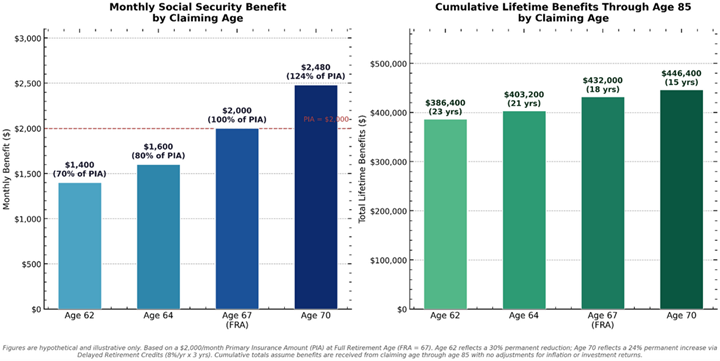
Your Social Security claiming age is one of the most important retirement decisions you’ll make. Claiming early (as soon as age 62) means a permanent reduction in your monthly benefit. If your Full Retirement Age (FRA) is 67, claiming at 62 locks in a 30% cut for life.
How long you live decides which choice wins, and that is the part people guess at. J.P. Morgan gives a non-smoking woman in excellent health who is 65 today a 54% chance of reaching 90 and a man a 43% chance, and for a couple the odds one of them gets there are 74%.2 Before you pick a claiming age you should know how long that check may have to keep coming.
Waiting until FRA (66 for those born 1943 to 1954, gradually rising to 67 for those born 1960 or later) gives you your full benefit. If you delay past FRA, your benefit grows by 8% per year up to age 701 (plus the annual Cost of Living Adjustment, which has been about 2.56% over the last 25 years) for a total increase of up to 24% or more if you wait from 67 to 70. There’s no extra credit for waiting past 70.
What Waiting Actually Buys: 62 Versus 70
The percentages above are the machinery. Here is what they look like in dollars. This is one illustrative married couple, each having earned about $75,000 a year, with the projection run from age 55 using the Social Security Administration’s own retirement estimator and the cost-of-living adjustment that SSA itself builds into its future-dollar estimates.
| Claim age | Illustrative household Social Security |
|---|---|
| 62 | about $50,500 a year |
| 70 | about $118,500 a year |
Illustrative and hypothetical, one couple, as of 2026. Figures come from the Social Security Administration’s estimator at ssa.gov and are stated in future dollars, which include SSA’s assumed cost-of-living adjustments. Your own result depends on your earnings record and is subject to change. There are claim ages in between 62 and 70; the two ends are shown to make the range clear.
Look at that spread. Same two people, same lifetime of work. The only difference between those two numbers is patience. Anyone can reproduce it by entering the same scenario at ssa.gov.
Lifetime and Survivor Income
Delaying Social Security doesn’t just boost your own monthly check. It can also increase the survivor benefit for your spouse. If you’re the higher earner and you delay, your surviving spouse can receive up to 100% of your higher benefit, including any increases from waiting. This can make a big difference for couples, especially if one spouse expects to outlive the other.
There is a second half to this that often gets missed. When one spouse passes away, the household keeps the larger of the two Social Security checks and loses the smaller one. That drop is part of what is called the widow’s penalty, and it hits widowers exactly the same way.
Two things happen to the survivor at once, and they are separate. Household income falls, because one of the two checks goes away. And taxes can rise, because the survivor often files in the higher single brackets instead of joint. Waiting to claim makes the check the survivor keeps a bigger one, which softens the first of those two hits for the person left behind.
Taxes and IRMAA
Social Security benefits can be taxed at the federal level, depending on your total income. For 2026, up to 85% of your benefits may be taxable if your combined income is over $34,000 (single) or $44,000 (married filing jointly). Claiming early can push more of your benefits into the taxable range, especially if you’re also drawing from IRAs or other accounts.
Higher income can also trigger Medicare’s IRMAA surcharges, which raise your Part B premium from $202.90 to $284.10 per month, plus $14.50 on top of your Part D premium, for singles with income just $1 over $109,000 in 2026. There are more income tiers with higher surcharges. IRMAA is based on your income from two years prior, so planning ahead is key.
Break-Even Ages and Longevity
The “break-even age” is when the total value of waiting to claim surpasses the total you’d get by claiming early. For most people, the break-even point for claiming at 62 versus 67 is around age 78 or 79. For waiting until 70, it’s usually age 80 or 81. If you expect to live into your 80s or beyond, waiting can pay off. If your health or family history suggests a shorter lifespan, claiming earlier may make sense.
Research suggests a 65-year-old male has a 50% chance of living past about age 86. It is age 89 for a 65-year-old female, and for a couple aged 65, there is a 50% chance one of you would live past age 94.
Playing the “well, I put in my money into Social Security, so I’m going to get it out” mentality could easily mean living a lesser lifestyle in retirement. Keep that in mind.
Flexibility with Lifestyle-First Planning
Traditional advice sometimes pushes people to claim early if markets drop, just to avoid selling investments at a loss. Lifestyle-First planning changes the game by using Protected Lifetime Income (PLI) to cover essentials, so you don’t have to rush your Social Security decision. You can coordinate withdrawals from Roth IRAs or taxable accounts to bridge the gap, keeping your income and taxes lower until you’re ready to claim.
Depending on how much retirement wealth you’ve built up, there are other very interesting strategies to create an income bridge for that Social Security income from age 62 to 70, or whatever age you’re wanting to retire. Book a call at the link above or below to learn more.
How the Bigger Check Does Real Work in Your Plan
This is the part that gets missed. A bigger Social Security check is not just more spending money. It changes how your whole plan gets built.
Your income floor, the guaranteed, protected money that covers your life, is built from a few pieces. Social Security sits underneath it. If you have a pension, that sits there too. On top of those, Protected Lifetime Income (PLI) fills the gap up to the life you actually want.
Here is what waiting does. The bigger your Social Security check, the smaller the gap PLI has to fill. A smaller gap means less of your savings gets committed to the guaranteed income floor, which means more of your savings stays in your growth account, largely untouched and free to grow. Waiting to claim does not just buy a bigger government check. It frees up more of your own money.
That said, waiting is not what decides whether you can retire at 55 or 60 in the first place. That rides on how much income you want and how much you have saved, a point we walk through in the Social Security question everyone asks first about early retirement. Waiting to claim makes a workable plan run leaner. It does not turn an unworkable one into a workable one. A properly built income bridge is what gives you the freedom to wait, because you are not leaning on Social Security to eat in those early years. The income bridge buys you the option to wait. Waiting buys you the bigger check for life.
Special Rules and Options
If you claim and change your mind within 12 months, you can withdraw your application and repay all benefits received (including those paid to family members), but you can only do this once in your lifetime.
After 2034, if Congress doesn’t act, Social Security is projected to pay about 83% of scheduled benefits, not zero. Survivor benefits, tax rules, and IRMAA surcharges all add layers of complexity, so it pays to plan ahead. This doesn’t mean Social Security is going away or you’ll lose all your benefits. It means you could lose about 17% of what you expected. Don’t let fear push you into a poor decision, because 83% of your benefit at 70 is still much higher than 83% of claiming earlier.
Myths and Truths
- Myth: “There’s a perfect age for everyone to claim Social Security.”
Truth: The best age depends on your health, family history, income needs, and other sources of retirement income. There’s no universal answer. - Myth: “If I claim early, I can just increase my benefit later.”
Truth: Claiming early locks in a permanent reduction. You can only withdraw your application within 12 months, repay all benefits, and reapply once in your lifetime. - Myth: “Delaying always means more total money.”
Truth: Delaying increases your monthly benefit, but you’ll need to live past the break-even age (late 70s to early 80s) for the higher payments to outweigh the years you skipped. - Myth: “Social Security isn’t taxed.”
Truth: Up to 85% of your benefits can be taxable if your income is above certain thresholds. Those thresholds were created in 1983 and have never been adjusted for inflation. - Myth: “IRMAA only affects the wealthy.”
Truth: The first IRMAA surcharge tier starts at $109,001 for single filers in 2026. Even a small increase in income can trigger higher Medicare premiums. - Myth: “If I delay, my spouse won’t benefit.”
Truth: If you’re the higher earner, delaying can increase the survivor benefit your spouse receives if you pass away first.
What Is One of the Biggest Mistakes People Make With Social Security?
Claiming early without counting what it costs for the rest of your life, and for your spouse’s.
Researchers estimate that more than 90% of workers ages 45 to 62 would come out ahead by waiting until 70, but only about 10% wait that long. For the median household, they put the loss at about $182,000 of lifetime spending.3 In 2024, about 22% to 23% of new retirement awards went to people who were 62, and only about 8% to 9% to people 70 to 74.4
The cost doesn’t stop with you. If the higher earner claims early, the surviving spouse’s check is generally capped at the larger of that reduced benefit or 82.5% of the full benefit.5 That’s less than if the higher earner had waited. That’s the check the survivor lives on for the rest of their life.
A second common mistake: claiming early and then going back to work. In 2026, Social Security holds back $1 for every $2 you earn over $24,480 until you reach full retirement age.6 That money isn’t gone for good. Once you reach full retirement age, 67 if you were born in 1960 or later,7 Social Security raises your monthly check to credit the months it held back.6
Pros and Cons
Pros of Claiming Early (age 62 to 64):
- Provides income sooner if you need it
- May make sense if you have health concerns or a shorter life expectancy
- Can help bridge a gap if you retire before other income sources start
Cons of Claiming Early:
- Permanent reduction in monthly benefit (up to 30% less if FRA is 67)
- Lower survivor benefit for your spouse
- More of your benefit may be taxable, and higher income could trigger IRMAA surcharges
Pros of Delaying (to FRA or age 70):
- Higher monthly benefit for life (up to 24% more if you wait from 67 to 70)
- Larger survivor benefit for your spouse
- More flexibility to manage taxes and IRMAA by using Roth or taxable withdrawals as an income bridge
Cons of Delaying:
- You’ll need other income sources to cover expenses while you wait
- If you don’t live past the break-even age (late 70s to early 80s), you may receive less in total benefits
- Requires careful coordination with other parts of your retirement plan
Visual Guide: How Claiming Age Affects Your Benefits
Summary
There’s no single “right” age to claim Social Security. The best choice depends on your health, family situation, and income needs. Lifestyle-First planning helps you coordinate Protected Lifetime Income (PLI), withdrawals, and Social Security so you can claim when it’s right for you, not because you’re forced to by a market drop or tax surprise. With the right plan, you can maximize your benefits and protect your lifestyle.
All figures are historical, hypothetical, or illustrative and are not guarantees of future results. Social Security rules, tax laws, and Medicare premiums are current as of 2026 and may change. This content is for educational purposes only and does not constitute personalized advice.
Social Security alone won’t cover the retirement you’ve been picturing.
For many retirees, Social Security covers some of the essentials. It won’t cover the adventures, the time with the grandkids and the memories you’ve been saving for. What fills that gap, and whether it lasts, is the real question. In a free 15-to-30-minute Retirement Income Blueprint Call, we look at how your Social Security fits with the rest of your income. First your life, then your money.
We’ll focus on your lifestyle first, so you can spend with confidence and enjoy the retirement you’ve earned.
Return to the Retirement Income Answers Hub
Frequently Asked Questions
What happens if I claim Social Security at 62 instead of my full retirement age?
Claiming at 62 locks in a permanent reduction. If your Full Retirement Age is 67, claiming at 62 cuts your monthly benefit by 30% for life, and that reduction does not reverse itself later.
How much more do I get by waiting until 70?
Once you pass Full Retirement Age, your benefit grows about 8% per year up to age 70, plus the annual Cost of Living Adjustment, which has averaged about 2.56% over the last 25 years. Waiting from 67 to 70 can raise your benefit by 24% or more. There is no additional credit for waiting past 70. In dollar terms, one illustrative couple each earning about $75,000, projected from age 55 on the Social Security Administration’s own estimator, shows about $50,500 a year for the household claiming at 62 versus about $118,500 claiming at 70.
What is the break-even age for waiting to claim Social Security?
For most people the break-even point for claiming at 62 versus 67 falls around age 78 or 79. For waiting until 70, it is usually age 80 or 81. Research suggests a 65-year-old man has about a 50% chance of living past 86, a 65-year-old woman close to 89, and for a couple aged 65 there is roughly a 50% chance one of them lives past 94.
How does my claiming age affect my spouse’s survivor benefit?
Delaying does not only raise your own check. If you are the higher earner and you delay, your surviving spouse can receive up to 100% of your higher benefit, including the increases you earned by waiting. For couples where one spouse expects to outlive the other, this is often the larger part of the decision.
Can claiming early raise my taxes or Medicare premiums?
It can. For 2026, up to 85% of your benefits may be taxable if your combined income is over $34,000 filing single or $44,000 filing jointly. Claiming early while also drawing from IRAs can push more of your benefit into the taxable range. Higher income can also trigger Medicare IRMAA surcharges, which raise the Part B premium from $202.90 to $284.10 per month, plus $14.50 on top of the Part D premium, for a single filer whose income is just $1 over $109,000 in 2026.
Can I change my mind after I claim Social Security?
Yes, but the window is narrow. If you withdraw your application within 12 months of claiming, you can repay all benefits received, including any paid to family members, and reset the decision. You can only do this once in your lifetime.
Will Social Security still be there if I wait?
Current projections show that after 2034, if Congress does not act, Social Security would pay about 83% of scheduled benefits, not zero. That is a reduction, not a disappearance. Keep in mind that 83% of a benefit claimed at 70 is still well above 83% of a benefit claimed early, so fear of a shortfall is a poor reason to claim before you are ready.
Can I claim Social Security if I retire at 55 or 60?
No. The earliest you can claim is 62. If you retire before then, you build an income bridge to carry your full paycheck through the years until Social Security turns on. Once it does, it joins your income floor for the rest of your life.
Related Retirement Income Questions
How much income will $500,000 generate in retirement?
See how $500,000 can translate into steady, spendable income, plus why the old 4% rule can fail and how Social Security timing fits into your retirement income plan.
How much do I need to retire?
It’s not about a magic number. It’s about matching your income to your essentials and non-negotiable experiences, so you can retire with confidence.
What is guaranteed retirement income?
Guaranteed retirement income means steady, predictable paychecks for life, covering essentials and experiences, no matter what the market does.
How do taxes, IRMAA, and market drops fit in?
Taxes, Medicare IRMAA surcharges, and market downturns can all impact your retirement income and your Social Security claiming decision. Planning ahead helps you avoid surprises.
How do Roth conversions lower lifetime taxes?
Roth conversions can reduce future RMDs, lower taxable income, help you avoid IRMAA surcharges, and give you more flexibility when deciding when to claim Social Security.

Experience: Since founding KJ Financial in 2010, Kurt H. Jackson has worked with retirees and pre-retirees across Missouri, Nebraska, Kansas, Iowa, and Florida who discovered that the retirement plan they had built around a fixed withdrawal rule was far more fragile than they realized. He has worked directly with clients coming out of the 2008 crash, and with clients who retired into the 2020 COVID drop and the inflation spike of 2021 to 2023, and he has seen firsthand what sequence of returns risk does to a withdrawal-only strategy versus a Lifestyle-First plan with a guaranteed income floor. Before founding KJ Financial, he spent 20 years as a Certified Mortgage Planner working with more than 1,000 clients on major financial commitments, giving him deep insight into how financial decisions compound over time.
Expertise: Kurt is a Retirement Lifestyle Architect and the creator of the Lifestyle-First Retirement Income Planning framework. He builds guaranteed lifetime income, which he calls Protected Lifetime Income (PLI), under both his clients’ essentials and their non-negotiables, the adventures, the experiences and the memories with those they care about. With that income floor in place, the rest of their money no longer has to pay the bills, which means it doesn’t have to be sold in a down market. He is Life and Health Insurance Licensed in MO, NE, KS, IA, and FL. His practice focuses exclusively on insurance-based, tax-optimized retirement income strategies. He does not manage investments or sell securities.
Authoritativeness: Kurt founded KJ Financial and operates MaxMyRetirementIncome.com as a dedicated educational resource for retirees. His work is grounded in peer-reviewed and independently published research, cited directly on each page. He applies that research to the practical income planning decisions retirees face every day in the states he serves.
Trustworthiness: KJ Financial is a compliance-first firm. All figures and research citations on this page are sourced from publicly available, independently published studies and are linked directly in the content. Kurt is paid by commission from the insurance company that issues the policy. Kurt H. Jackson is not a securities broker, registered investment advisor, or CPA. Guarantees rely on the claims-paying ability of the issuing insurance company.
Contact KJ Financial:
1014 E. 5th St., Maryville, MO 64468
Direct: 816.582.5532
Email: kurt@kjfinancialonline.com
Website: www.MaxMyRetirementIncome.com
Sources
- Social Security Administration, Delayed Retirement Credits. Social Security’s own table giving a 12-month rate of increase of 8.0 percent for anyone born in 1943 or later, which applies only after full retirement age and stops at age 70.
- J.P. Morgan Asset Management, Guide to Retirement 2026, the Life Expectancy Probabilities page. J.P. Morgan’s own longevity chart for a non-smoker in excellent health who is age 65 today, giving a man a 64% chance of reaching 85, 43% of 90, 21% of 95 and 6% of 100; a woman 73%, 54%, 30% and 11%; at least one member of a couple 90%, 74%, 44% and 16%; and both members of a couple 47%, 23%, 6% and 1%.
- Altig, Kotlikoff and Ye, “How Much Lifetime Social Security Benefits Are Americans Leaving on the Table?” NBER Working Paper 30675. (November 2022)
- The Social Security Administration’s Annual Statistical Supplement 2025, table 6.B5.
- Social Security’s operations manual, section RS 00615.320, explains the limit on a widow’s or widower’s benefit when the deceased claimed early.
- The Social Security Administration explains the 2026 earnings limits and that it recalculates your benefit to credit months it withheld.
- The Social Security Administration’s chart shows full retirement age by year of birth.
Educational only, not tax, legal, or individualized investment advice. Guarantees rely on the issuing insurer’s claims-paying ability. All figures are illustrative and may differ for your situation based on age, health, product features, fees, allocations, and market conditions.
Related: the widow’s penalty and why survivor income matters to the claiming decision
Related: should you quit your job to care for an elderly parent?
See it on your own numbers
Want to see your own Tax Avalanche?
A general warning is easy to wave off. Your own number is a lot harder to ignore. Put in a few rough figures and watch the cascade unfold, the withdrawal the government will force you to take, how much of your Social Security it can drag into being taxed, and what it can do to whichever spouse is left behind. It takes about two minutes, and you walk away with a one-page snapshot to keep.
Show me my Tax Avalanche