How Does Sequence of Returns Risk Threaten Retirees Even With Average Returns?
Last updated: September 10, 2026
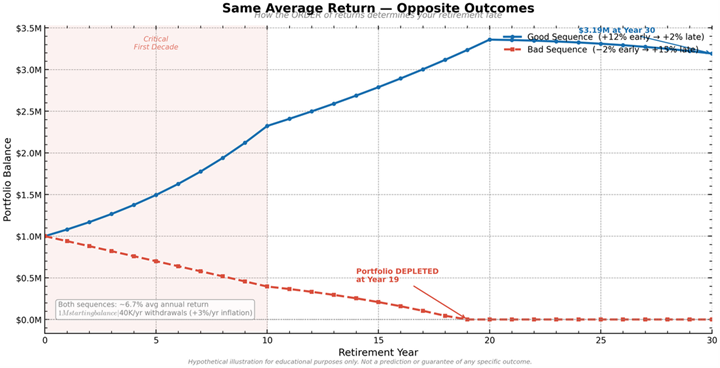
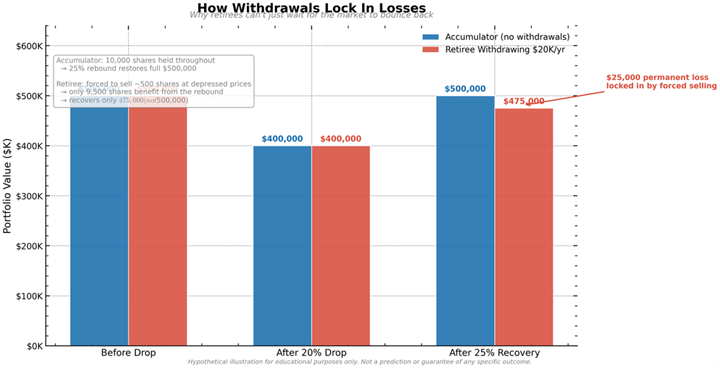
Sequence of returns risk means that poor markets early in retirement can permanently damage your withdrawal strategy, even if your average return over 30 years is strong. When you are withdrawing money during a downturn, you are forced to sell more shares at depressed prices. Those shares are gone permanently. When markets recover, you have fewer shares left to participate in the rebound. Research by Dr. Wade Pfau shows approximately 77% of your final retirement outcome is determined by returns in just the first 10 years of retirement, while the returns over the final 20 years determine only 5%.1 The timing of gains and losses matters far more than the average. Lifestyle-First planning uses guaranteed lifetime income, which we call Protected Lifetime Income, or PLI for short, to shield your essentials and your non-negotiables from this risk so you don’t have to sell investments at the worst possible time. To see how this plays out in dollars, look at a $1 million retirement example.
The same Sequence of Returns Risk happens on a smaller scale all year long. We ran the S&P 500 daily closes back to January 1950. The index finished lower than the day before on 46.2% of all trading days, and no decade in that stretch came in under 43% or over 49%.2
Some retirees take income once a year. Some take it quarterly. Some take it every month. Whichever one you are, the day your money comes out has nothing to do with what the market did that week. One year the timing might treat you well. The next year it might not, and there is no way to know until after.
Sequence of returns risk gets explained in years. It is happening far more often than that.
Doesn’t that sound like a lot more risk than you think you’re taking?
To see exactly how this plays out for someone with $600,000, read is $600,000 enough to retire, including the sequence-of-returns scenario that flips the outcome.
What happens if the market drops the year you retire?
A big drop in the first few years of retirement can do far more damage than the same drop later on, because you’re pulling money out while it’s down. Add years of rising prices, and the plan that looked safe on paper can start to come apart. If your retirement income depends on the market behaving, you’re betting on something nobody can predict. Book a free 15-to-30-minute Retirement Income Blueprint Call and see how your income would hold up. First your life, then your money.
What Is Sequence of Returns Risk?
Sequence of returns risk is one of the most important and least understood threats to retirement security. Most people focus on average investment returns when planning for retirement. But in retirement, when you are withdrawing from your portfolio rather than adding to it, the order those returns arrive matters far more than the average.
Here is why. If markets drop early in your retirement while you are withdrawing money to cover expenses, you are forced to sell more shares at depressed prices to generate the same income. That permanently reduces the number of shares left to recover when markets bounce back. Even if markets produce strong returns over the following 20 years, your portfolio may never fully recover from the damage done in those first few bad years. That’s what happened to the Parkers in our example: five big years in a row came too late, and they still ran out of money at 89. As Dr. Wade Pfau explains: a portfolio taking withdrawals is permanently impaired by early losses in a way that a portfolio purely growing with no withdrawals is not. See Pfau’s sequence of returns risk white paper.
Why the First 10 Years Make or Break Your Retirement
Dr. Pfau’s research shows that approximately 77% of your portfolio’s final outcome is determined by the returns in just the first 10 years of retirement, while the returns over the final 20 years determine only 5%. That is a striking and important finding. It means that two retirees with identical 30-year average returns can end up in completely different financial situations depending purely on when the bad years hit.
If the bad years come early, when you are still withdrawing money regularly, the damage can be permanent. If they come late, after your portfolio has had a decade or more to grow, you can absorb them without lasting harm. The math is not symmetric. Early losses during withdrawals hurt far more than late losses.
You do not have to retire into a crash to feel this. We took the largest market fall from a high to a low in every calendar year since 1950. It averages 13.7%, and every one of those 76 years had one. Even the 55 years that finished higher still fell 10.4% at some point during the year.2
Should a retiree who is taking income be worried about bad market years showing up and impacting their income? When you take a deeper look into how the market behaves you begin to see why they would be concerned. In addition to those big annual market drops, there are the down days we started with. The market closes lower than the day before on about 46% of all trading days.2 These drops take place in the up years too, not just the bad ones.
Contrary to what traditional planning models tend to assume, retirees who are depending on the market to deliver their retirement income and their legacies end up watching the market almost on a daily basis. It could be them seeing these down market days and the deeper drops every year that is creating a fear to spend their retirement savings.
This then creates a double-edged sword, losing money and reduced spending in retirement. Does that sound like a great successful retirement to you?
An income floor takes that away at the source. When your essential spending is already covered, what the market does on any given day stops deciding how you live.
Same Average Return, Opposite Outcomes
How Withdrawals Lock In Losses Permanently
Real-World Examples of Sequence Risk in Action
The 1973 to 1974 Bear Market
The S&P 500 dropped 48% and inflation averaged 9.3% per year. A retiree who began withdrawals in 1973 lost approximately 30% of their savings in just two years before accounting for inflation. Kitces research illustrates the dramatic impact of timing: a retiree who retired at the start of this crisis finished with $278,000 after 30 years, while a retiree who retired just two years later, after the recovery had begun, finished with $3.36 million. Their long-term average returns were nearly identical. Only the sequence was different. See the Kitces research.
The 2000 to 2002 Dot-Com Crash
The S&P 500 lost 47.2%. A retiree with a $1,000,000 portfolio withdrawing $40,000 per year would have seen their balance nearly cut in half by the end of the third year of retirement. Even though markets eventually recovered, those early withdrawals locked in losses that could not be recovered. See Investopedia on sequence risk.
The 2008 to 2009 Financial Crisis
The S&P 500 fell 54%. Retirees who had just begun withdrawals saw dramatic portfolio declines. Because the market rebounded relatively quickly compared to the 1973 to 1974 period, most portfolios following a 4% withdrawal strategy were able to recover. This illustrates that the duration of a downturn matters as much as its depth. A short, sharp crash is far less damaging to a withdrawal strategy than a prolonged bear market in the early years of retirement.
The Mason vs. Dixon Story
Mason retired in 1983 with just over $400,000 and ended with nearly $2.7 million after 30 years of withdrawals. Dixon retired in 1967 with over $2.1 million, more than five times Mason’s starting wealth, but ran out of money before 30 years due to poor early returns and high inflation in the first decade. Starting wealth was essentially irrelevant. Sequence was everything. See the Kitces research.
How Much Did Retirees Have to Cut Their Spending?
Portfolio losses are only half the story. The other half is what happened to the retiree’s paycheck. A study tested the Guyton-Klinger guardrail rule, which cuts spending when the portfolio falls too far, through real market history:
- Retiring in 2007, just before the financial crisis: spending fell to 28% below plan, and it took over a decade to get back.10
- Retiring in 1999, just before the dot-com crash: spending fell to 36% below plan.10
- Retiring in January 1936, during the Great Depression era: spending fell to 45% below plan.10
- Retiring in October 1965, just ahead of the 1970s stagflation: spending fell to 54% below plan, for more than a decade.10
A newer version, risk-based guardrails, cut less: 3%, none, 8% and 32%.10 Even so, the 1965 retiree still had to live on about a third less for several years. If you had to cut your spending, or felt like you had to, would you call that a successful retirement?
What the Research Says About Protecting Against Sequence Risk
- Morningstar 2025: Recommends a 3.9% safe starting withdrawal rate for a 90% probability of not outliving savings over 30 years3, lower than the traditional 4% rule, specifically because of today’s elevated valuations and heightened sequence risk. See the Morningstar research.
- BlackRock and EBRI: Adding a guaranteed income floor can increase potential retirement spending by an average of 22% compared to withdrawal-only strategies, because you never have to sell investments at a loss to cover essential expenses.4 See the BlackRock whitepaper.
- Blanchett, Finke, and Pfau: Retirees with higher levels of Protected Lifetime Income can safely spend at rates approaching 6%, compared to much lower sustainable rates for those relying entirely on portfolio withdrawals. See the research.
- Guardrails strategies: Dynamic withdrawal strategies that adjust spending up or down based on portfolio performance support a higher starting withdrawal rate, 5.2% against 3.9% for a static rule. See the Morningstar guardrails research.
How Lifestyle-First Planning Shields You from Sequence Risk
Lifestyle-First planning addresses sequence risk at its source rather than trying to manage around it. The core problem with any withdrawal-only strategy is that your essential spending depends on market performance. When markets fall, you are forced to sell to pay your bills. That is the damage mechanism. Lifestyle-First planning eliminates it.
Essential expenses and non-negotiable experiences are covered by Protected Lifetime Income first. That income arrives every month regardless of what markets do. A market drop in year two of your retirement cannot threaten your housing, healthcare, food, or the experiences that define your retirement. Your growth assets can stay invested through downturns and participate fully in recoveries without being depleted at the worst possible time.
This also changes how you experience market volatility emotionally. Instead of watching a portfolio decline and calculating how many months of expenses remain, you know your income floor is secure. The market becomes an opportunity for your growth assets rather than a threat to your lifestyle. That is a fundamentally different retirement experience, and it is backed by research showing 22% more potential spending power on average compared to withdrawal-only approaches.
Myths and Truths About Sequence of Returns Risk
- Myth: Sequence risk only matters if you retire right before a major crash.
Truth: Even moderate downturns early in retirement cause lasting damage to a withdrawal strategy because you are forced to sell more shares at low prices, reducing what is left to recover. - Myth: If my average return over 30 years is good, I will be fine.
Truth: The order of returns matters far more than the average. Dr. Pfau’s research shows 77% of your final outcome is determined by the first 10 years, and the final 20 years determine only 5%. Two retirees with identical averages can end up in completely different financial situations. - Myth: You can just wait for markets to recover after a bad year.
Truth: Withdrawals during downturns lock in losses permanently. When markets recover, you have fewer shares than you would have had without withdrawing, and that gap never fully closes. - Myth: The 4% rule protects against sequence risk.
Truth: Morningstar’s 2026 research recommends starting at 3.9% for 90% confidence over 30 years, and even that can fail if poor markets arrive early. The 4% rule does not eliminate sequence risk. It simply sets a withdrawal level that has survived most historical sequences in past data. - Myth: Protected Lifetime Income means giving up growth potential.
Truth: PLI covers both your essentials and your non-negotiables, the adventures, the experiences and the memories with those you care about. Everything above that stays in growth assets. Once those are secured, many clients invest their remaining assets more confidently, not less. - Myth: Guardrails strategies fully solve the sequence risk problem.
Truth: Guardrails significantly reduce sequence risk and support a higher starting withdrawal rate, 5.2% against 3.9% for a static rule. But they cannot fully protect essential spending during a prolonged downturn because your basic expenses are still tied to portfolio performance. PLI takes your essentials and your non-negotiables out of the market, so a downturn doesn’t force you to cut them.
Pros and Cons of Protecting Against Sequence Risk
Pros of Lifestyle-First Planning with PLI:
- Essential spending and your non-negotiables, the adventures, the experiences and the memories with those you care about, are covered by guaranteed income that markets cannot touch
- Growth assets can stay invested through downturns without being forced to liquidate at losses
- Eliminates the anxiety and behavioral risk that comes from market-dependent essential spending
- BlackRock and EBRI research supports 22% more potential spending power versus withdrawal-only strategies
- Retirees with higher PLI levels can safely spend at rates approaching 6% according to Blanchett, Finke, and Pfau research
Cons to Keep in Mind:
- Requires upfront planning to correctly size your income floor and select appropriate PLI solutions
- Some assets are committed to protected income, which reduces near-term liquidity for other goals
- Ongoing annual review is needed to adjust for inflation, healthcare costs, and changing circumstances
- Transitioning from a withdrawal-only mindset to a two-layer structure requires learning and adjustment
Summary
Sequence of returns risk is real, it is measurable, and it is one of the primary reasons well-funded retirements fail. The order of returns in your first decade of retirement matters far more than your lifetime average return. The most effective defense is a guaranteed income floor that covers your essential expenses regardless of what markets do, freeing your growth assets to do their job without being depleted at the worst possible time. When you combine Protected Lifetime Income for essentials with growth assets and dynamic withdrawals for everything else, you have a retirement structure that is built to withstand what markets actually do, not just what they average.
If the market crashed the year you retired, would your income survive?
This is also how the sequence of returns changes a safe withdrawal rate.
Frequently Asked Questions
How do I protect against both inflation and sequence risk at the same time?
The two-layer approach addresses both simultaneously. Protected Lifetime Income for essential expenses eliminates sequence risk for your core lifestyle. Growth assets positioned for long-term purchasing power address inflation. Because the growth layer is not needed for immediate expenses, it can stay invested through downturns and recover fully rather than being depleted when prices are lowest.
Why does the 4% rule fail to protect against sequence risk?
The 4% rule assumes a fixed withdrawal percentage from a market-dependent portfolio. When markets fall early in retirement, you withdraw more shares than you would in a good market to generate the same dollar amount. Those extra shares sold at depressed prices are permanently gone, and the 4% rule provides no mechanism to compensate for that damage. Morningstar’s 2026 research now recommends starting at 3.9% for 90% confidence, and even that carries a 10% failure rate driven primarily by adverse sequences.
Is a Protected Lifetime Income solution the right tool to address sequence risk?
For the specific job of removing essential spending from market dependence, a fixed indexed annuity with a GLWB is the most effective tool currently available. When your bills are covered by guaranteed income, you never have to sell growth assets during a downturn. Sequence risk becomes irrelevant for your essential lifestyle, which is the goal. The trade-offs of reduced liquidity and insurer dependence need to be understood and weighed carefully.
What is a smart withdrawal strategy that reduces sequence risk?
Cover your essentials and your non-negotiables, the adventures, the experiences and the memories with those you care about, with Protected Lifetime Income first. The rest of your money no longer has to pay the bills, which means it doesn’t have to be sold in a down market. That takes sequence risk off the spending that matters most.
Can guardrail strategies prevent spending cuts on their own?
Guardrails can significantly reduce the frequency and severity of spending cuts compared to static withdrawal rules, and support a higher starting withdrawal rate, 5.2% against 3.9% for a static rule. Reducing the cuts is not the same as removing them. Guardrails cannot fully eliminate the risk of pulling back during a prolonged downturn, because the spending is still tied to portfolio performance. Guaranteed lifetime income, which we call Protected Lifetime Income, takes your essentials and your non-negotiables out of the market entirely, and it typically pays more than any of these rates do, especially when it is put in place before you retire.
Is the 4% rule still safe given today’s sequence risk environment?
Morningstar’s 2026 research recommends starting at no more than 3.9% for 90% confidence over 30 years, and the Shiller CAPE ratio is currently over 40, more than double its historical average. Elevated valuations mean lower expected future returns, which makes adverse sequences more likely and more damaging. For most retirees in 2026, relying entirely on a fixed withdrawal rule is a significant and unnecessary risk.
What is a retirement income floor and how does it neutralize sequence risk?
A retirement income floor is a guaranteed income stream that covers your essential expenses regardless of market conditions. When your bills are paid by protected income rather than portfolio withdrawals, a market downturn cannot force you to sell investments at a loss. Your growth assets can stay invested and recover fully without being depleted when prices are lowest. That is the mechanism that neutralizes sequence risk for your essential lifestyle.
How does the Social Security claiming age interact with sequence risk?
When your essential expenses are covered by Protected Lifetime Income, you are not forced to claim Social Security early to pay your bills during a market downturn. That flexibility often makes delaying to age 70 one of the highest-return decisions available. Waiting from full retirement age to 70 increases your benefit by up to 24% permanently, adding more guaranteed income to your income floor and further reducing your dependence on portfolio withdrawals during the critical early years.
Does Missouri tax Social Security, and how does that affect sequence risk planning?
As of 2026, Missouri fully exempts Social Security benefits from state income tax for anyone age 62 or older, with no income limits.5 This gives Missouri retirees more flexibility in managing their overall taxable income, which in turn affects how much they need to withdraw from growth assets each year and their exposure to IRMAA surcharges.
Does Florida tax Social Security, and how does that affect sequence risk planning?
Florida has no state income tax, so Social Security, PLI income, and investment withdrawals are all free from state taxation.6 This makes Florida one of the most efficient states for managing withdrawals and reduces the total amount retirees need to pull from growth assets each year.
Does Nebraska tax Social Security, and how does that affect sequence risk planning?
Nebraska fully exempts all Social Security benefits from state income tax with no income thresholds or phase-outs.7 Nebraska retirees have more flexibility in managing taxable income and reducing portfolio withdrawal pressure during the critical early years of retirement.
Does Kansas tax Social Security, and how does that affect sequence risk planning?
Kansas fully exempts all Social Security benefits for every resident, with no income threshold.8 PLI sizing and Roth conversion strategies remain important for Kansas retirees to reduce overall withdrawal pressure on growth assets and protect against sequence-of-returns risk in early retirement.
Does Iowa tax Social Security, and how does that affect sequence risk planning?
Iowa does not tax Social Security at any age and also exempts most other qualifying retirement income for residents age 55 or older.9 Iowa retirees have meaningful flexibility in managing their withdrawal needs and reducing portfolio dependence during the years when sequence risk is most dangerous.

Experience: Since founding KJ Financial in 2010, Kurt H. Jackson has worked with retirees and pre-retirees across Missouri, Nebraska, Kansas, Iowa, and Florida who discovered that the retirement plan they had built around a fixed withdrawal rule was far more fragile than they realized. He has worked directly with clients coming out of the 2008 crash, and with clients who retired into the 2020 COVID drop and the inflation spike of 2021 to 2023, and he has seen firsthand what sequence of returns risk does to a withdrawal-only strategy versus a Lifestyle-First plan with a guaranteed income floor. Before founding KJ Financial, he spent 20 years as a Certified Mortgage Planner working with more than 1,000 clients on major financial commitments, giving him deep insight into how financial decisions compound over time.
Expertise: Kurt is a Retirement Lifestyle Architect and the creator of the Lifestyle-First Retirement Income Planning framework. He builds guaranteed lifetime income, which he calls Protected Lifetime Income (PLI), under both his clients’ essentials and their non-negotiables, the adventures, the experiences and the memories with those they care about. With that income floor in place, the rest of their money no longer has to pay the bills, which means it doesn’t have to be sold in a down market. He is Life and Health Insurance Licensed in MO, NE, KS, IA, and FL. His practice focuses exclusively on insurance-based, tax-optimized retirement income strategies. He does not manage investments or sell securities.
Authoritativeness: Kurt founded KJ Financial and operates MaxMyRetirementIncome.com as a dedicated educational resource for retirees. His work is grounded in peer-reviewed and independently published research, cited directly on each page. He applies that research to the practical income planning decisions retirees face every day in the states he serves.
Trustworthiness: KJ Financial is a compliance-first firm. All figures and research citations on this page are sourced from publicly available, independently published studies and are linked directly in the content. Kurt is paid by commission from the insurance company that issues the policy. Kurt H. Jackson is not a securities broker, registered investment advisor, or CPA. Guarantees rely on the claims-paying ability of the issuing insurance company.
Contact KJ Financial:
1014 E. 5th St., Maryville, MO 64468
Direct: 816.582.5532
Email: kurt@kjfinancialonline.com
Website: www.MaxMyRetirementIncome.com
Educational only. Not tax, legal, or individualized investment advice. Guarantees rely on the issuing insurer’s claims-paying ability. Any figures shown are illustrative and may differ for your situation based on age, health, product features, fees, allocations, and market conditions. Portfolio sequence examples are hypothetical and for educational purposes only. Past performance does not guarantee future results. Always consult a qualified financial, tax, or legal professional for your specific situation.
A “safe” withdrawal rate is a probability, not a promise.
The 4% rule, guardrails and success scores all come down to odds. Odds that you won’t run out. Odds that you won’t have to cut back. Odds that inflation won’t eat away what your money can buy. Is that how you want to spend the next 30 years or more, watching your balance and hoping? In a free 15-to-30-minute Retirement Income Blueprint Call, we show you what guaranteed lifetime income, instead of odds, could look like. First your life, then your money.
Return to the Retirement Income Answers Hub
Sources
- Wade Pfau, sequence-of-returns and safe-withdrawal research.
- KJ Financial calculation from S&P 500 daily closing prices, January 3, 1950 through August 28, 2026. Two calculations from the same data. First, across 19,285 day-over-day closing changes the index finished lower than the prior close 8,911 times, which is 46.2%, higher 53.1% of the time and unchanged 0.7%, with every decade between 43.1% and 48.7% down days. Second, taking the largest peak-to-trough fall inside each calendar year and averaging across all 76 complete years from 1950 through 2025 gives 13.7%, with a decline occurring in every one of those years and no exceptions; in the 55 years that finished higher the average largest fall was still 10.4%. Both are measured on closing prices, which understates the true fall because a closing price misses the low the market touched during the day. Yahoo carries actual daily highs and lows only from January 2, 1962; measured that way, 1962 through 2025 averages 15.8%. Each year’s return is measured from its first close to its last close, the same window as the fall.
- Morningstar, “The State of Retirement Income” (2026).
- BlackRock, research on guaranteed income and retirement spending.
- Missouri Revised Statutes, Section 143.125, Social Security benefits income tax exemption. The Missouri statute itself. It defines Benefits as Social Security received by a taxpayer age sixty-two years of age and older, or Social Security disability benefits, sets the exemption at 100 percent, and states that for all tax years beginning on or after January 1, 2024 a taxpayer receives the maximum exemption regardless of filing status or Missouri adjusted gross income.
- Constitution of the State of Florida, Article VII, Section 5(a). The state constitution itself, which says no tax upon the income of natural persons who are residents or citizens of the state shall be levied by the state, which is why Florida has no personal income tax on Social Security, IRA withdrawals or annuity income.
- Nebraska Revised Statutes, Section 77-2716(14). The Nebraska statute itself, which reduces federal adjusted gross income by one hundred percent of Social Security benefits for taxable years beginning on or after January 1, 2024, and defines Social Security benefits as benefits received under the federal Social Security Act.
- Kansas Statutes Annotated, 79-32,117(c)(xviii)(B). The Kansas statute itself, which subtracts from income, for all taxable years beginning after December 31, 2023, amounts received as benefits under the federal Social Security Act that are included in federal adjusted gross income. There is no age condition and no income condition; the former $75,000 ceiling ended with tax year 2023.
- Iowa Department of Revenue, IA 1040 Schedule 1 expanded instructions. Iowa’s own line-by-line instructions, where Line 5, Social Security Benefits, sits in the subtraction column with no age condition and no income condition. The age 55 condition that is often misread as applying to Social Security belongs to Line 7, IRA, pension and railroad retirement income.
- Derek Tharp and Justin Fitzpatrick, Kitces.com, “Why Guyton-Klinger Guardrails Are Too Risky For Most Retirees (And How Risk-Based Guardrails Can Help)” (March 27, 2024). A study that ran Guyton-Klinger and risk-based guardrails through four real retirement start dates and measured how far spending fell below plan.