Can Bucket or Guardrail Strategies Prevent Spending Cuts in Retirement?
Last updated: September 10, 2026
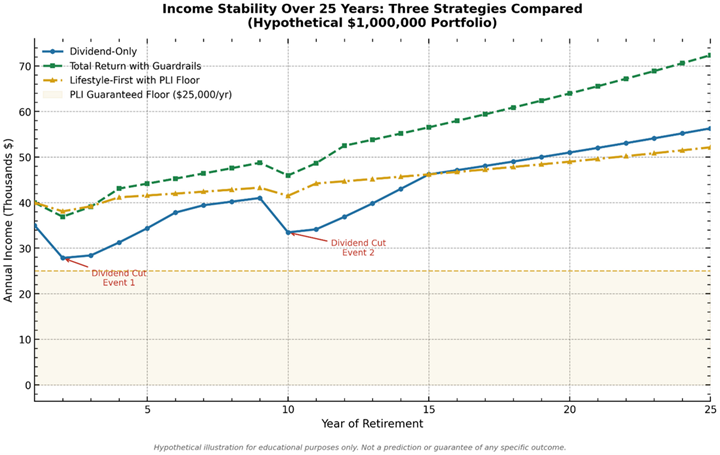
Bucket and guardrail strategies can delay or formalize spending cuts, but they cannot prevent them if markets underperform long enough. If your essential lifestyle depends on portfolio withdrawals, sequence of returns risk remains fully in play. Under the Guyton-Klinger guardrail rule, a retiree who started in 2007 saw spending fall to 28% below plan, and one who started in October 1965, just ahead of the 1970s stagflation, fell to 54% below plan. A newer version, risk-based guardrails, cut much less but still cut 32% in that 1965 case.10 Guaranteed lifetime income, which we call Protected Lifetime Income, is what actually removes forced cuts for essential expenses because it takes your must-have spending off the table entirely, making it independent of market performance.
What happens if the market drops the year you retire?
A big drop in the first few years of retirement can do far more damage than the same drop later on, because you’re pulling money out while it’s down. Add years of rising prices, and the plan that looked safe on paper can start to come apart. If your retirement income depends on the market behaving, you’re betting on something nobody can predict. Book a free 15-to-30-minute Retirement Income Blueprint Call and see how your income would hold up. First your life, then your money.
Watch: What a Success Score Is Really Measuring
Six minutes on where the 4 percent number came from, what a 90 percent success score actually tests, and what guardrails still ask you to do every year for the rest of your life.
The figures in this video were current when it was recorded. Income factors change over time. The principle does not. The numbers on this page are the current ones.
If you would rather watch than read, every one of my retirement planning videos is listed on one page.
What Is a Bucket Strategy and How Does It Work?
A bucket strategy divides your retirement savings into separate pools based on when you will need the money. The short-term bucket holds cash or stable assets to cover the next few years of spending. The middle-term bucket holds bonds for the next phase. The long-term bucket holds stocks for growth and eventual refilling of the earlier buckets as you spend them down.
The appeal is largely psychological. Seeing your near-term spending needs sitting safely in cash gives many retirees the confidence to leave their stock bucket invested through market downturns without panic-selling. That behavioral benefit is real and meaningful.
But research by Michael Kitces shows that bucket strategies produce the same mathematical outcome as a systematic withdrawal approach with simple rebalancing. As Kitces puts it, rebalancing alone already has an astonishingly powerful effect to help avoid unfavorable liquidations. The bucket structure does not create a mathematical edge. It creates a mental one. See the Kitces bucket strategy research.
Morningstar’s study of bucket strategies found that the time-bucket strategy offers the highest retirement spending and ending wealth, but it gets there by leaving you heavily in stocks late in retirement.9 That means the upside is real, but so is the downside in bad market environments.
What Is a Guardrail Strategy and How Does It Work?
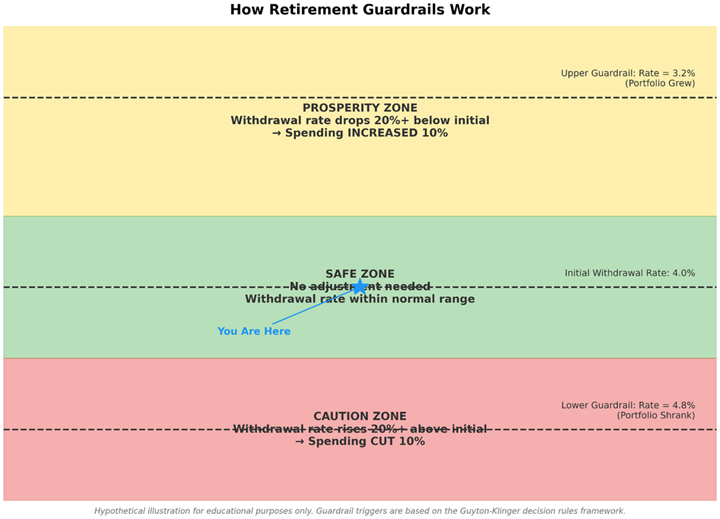
Guardrail strategies, most notably the Guyton-Klinger rules, start with an initial withdrawal rate, often 4% to 5%, and set upper and lower guardrails at 20% above and below that rate.
Those rates were likely tested against a fixed number of years, usually 30. J.P. Morgan gives a non-smoking couple in excellent health who are both 65 a 44% chance one of them reaches 95 and a 16% chance one of them reaches 100.3 The guardrails have nothing to say about the years past the test, so start with how long you are likely to be here.
- If your portfolio grows and your withdrawal rate drops 20% below your initial rate, you increase spending by 10%. That new higher amount becomes your baseline going forward.
- If your portfolio drops and your withdrawal rate rises 20% above your initial rate, you reduce spending by 10%. That new lower amount becomes your permanent baseline for future adjustments.
Some advisors use risk-based guardrails that adjust spending based on Monte Carlo probability of success thresholds, producing smoother, more gradual adjustments than the Guyton-Klinger rules. Adjustments are typically not made in the last 15 years of retirement under most guardrail frameworks. See the Kitces guardrail strategy research.
Do These Strategies Actually Prevent Spending Cuts?
The honest answer is no. Bucket and guardrail strategies manage and formalize spending cuts, which is meaningfully better than a static withdrawal rule, but they do not prevent cuts when markets underperform long enough, and that is the trap underneath all these strategies.
What Happens in Historically Bad Market Environments
The historical worst-case scenarios illustrate the real limitation of guardrail strategies for essential spending protection.
- Retiring in 2007, just before the financial crisis: Guyton-Klinger cut spending to 28% below plan, and it took over a decade to get back. Risk-based guardrails cut 3%.10
- Retiring in 1999, just before the dot-com crash: Guyton-Klinger cut spending to 36% below plan. Risk-based guardrails made no cut.10
- Retiring in January 1936, during the Great Depression era: Guyton-Klinger cut spending to 45% below plan. Risk-based guardrails cut 8%.10
- Retiring in October 1965, just ahead of the 1970s stagflation: Guyton-Klinger cut spending to 54% below plan, for more than a decade. Risk-based guardrails cut 32% for several years.10
- Wade Pfau’s computer simulations (not real history): Starting at a 4.8% withdrawal, the middle case had a 20% pay cut by year 10 and a 32% pay cut by year 20.10
These tests used a $1 million portfolio of 60% stocks and 40% bonds, starting with $43,000 a year. The study does not say whether advisory fees or fund costs were taken out.10
A cut of 28% to 54% below plan is not a minor adjustment. For a retiree whose entire lifestyle, housing, food, healthcare, and everything else depends on portfolio withdrawals, those cuts can be devastating. That is exactly what Protected Lifetime Income (PLI) is designed to prevent for your essentials and your non-negotiables. See the Kitces guardrail research.
Why Guardrails Still Beat the Static 4% Rule
Even with those limitations for essential spending protection, guardrail strategies are significantly better than a static 4% rule for discretionary spending management. Better than the 4% rule is not the same as better than income you cannot outlive. Guaranteed lifetime income, which we call Protected Lifetime Income, is not in that contest at all, and it will typically pay considerably more, especially when you set it up in the years before you retire.
- Morningstar’s 2026 research found that guardrail strategies support a higher starting withdrawal rate, 5.2% against 3.9% for a static rule.1 The extra income comes out of what is left at the end. Morningstar found that fixed real withdrawals produce the highest median balance at year 30.
- Morningstar’s 2026 research shows the guardrails method supports a 5.2% starting withdrawal rate at 90% confidence, compared to just 3.9% for a static rule. The 5.7% at the top of their range comes from two other flexible methods, not from guardrails. That means more income upfront with built-in safety mechanisms. See the Morningstar flexible strategy research.
The conclusion is not that guardrails are bad. They are clearly better than static rules for managing discretionary spending. The limitation is that they still cannot fully protect essential spending from prolonged market underperformance.
Three Strategies Compared: Static Rule, Guardrails, and Lifestyle-First with PLI
How Retirement Guardrails Work
What Only Protected Lifetime Income Can Do
Guardrail and bucket strategies are portfolio management tools. They organize and adjust how you draw from a market-dependent portfolio. But they cannot change the fundamental reality that if your essential spending comes from a portfolio, market performance ultimately determines whether you can sustain it.
Protected Lifetime Income is different in kind, not just in degree. It removes the market variable from your essential expenses entirely. Your housing, food, healthcare, and non-negotiable experiences are covered by contractually guaranteed income that does not depend on what markets do, what interest rates do, or how long you live. A 54% cumulative cut under stagflation conditions becomes irrelevant to your essentials and your non-negotiables when those are funded by the right amount of PLI.
The PLI income floor covers both your essentials and your non-negotiables, the adventures, the experiences and the memories with those you care about. That frees your investment portfolio from paying the bills, which means it doesn’t have to be sold in a down market, and it can keep growing for upgrades and legacy. A spending cut on the trips and time you planned your retirement around isn’t an inconvenience. It’s the retirement you didn’t get. PLI is built to prevent that.
BlackRock research shows retirees with a guaranteed income floor have 22% more potential spending power on average compared to withdrawal-only strategies.2 See the BlackRock income floor research. Combining PLI for essentials with guardrails for discretionary spending gives you the structural advantages of both approaches without the limitations of either alone.
Myths and Truths About Bucket and Guardrail Strategies
- Myth: Bucket strategies mathematically protect against sequence risk better than other approaches.
Truth: Research by Kitces shows bucket strategies produce the same mathematical outcome as total return with simple rebalancing. The benefit is behavioral, not mathematical. See the Kitces research. - Myth: Guardrail strategies prevent spending cuts entirely.
Truth: Guardrails formalize and reduce the frequency of cuts but do not prevent them. Under Guyton-Klinger rules, retirees who started in 2007 ended up 28% below planned spending, and those who started in October 1965 ended up 54% below.10 See the Kitces guardrail research. - Myth: Any smart withdrawal strategy can eliminate sequence of returns risk.
Truth: No withdrawal strategy eliminates sequence risk. They only manage it. Only Protected Lifetime Income takes essential spending off the table and makes it immune to market sequence. - Myth: Guardrail strategies mean giving up income potential compared to static rules.
Truth: The opposite is true. Morningstar’s 2026 research shows guardrails support a 5.2% starting withdrawal rate at 90% confidence, significantly higher than the 3.9% static rate. See the Morningstar research. - Myth: PLI replaces the need for any portfolio withdrawal strategy.
Truth: PLI covers essentials and non-negotiables. The rest of your money no longer has to pay the bills, which means it doesn’t have to be sold in a down market. You still decide when to draw on it for upgrades, gifts or legacy, without a withdrawal rule forcing you to cut back.
Pros and Cons of Each Approach
Pros of Bucket Strategies:
- Psychological comfort that helps retirees stay invested during market downturns
- Creates visual clarity around spending purpose and timing
- Supports behavioral discipline that prevents panic-selling
Cons of Bucket Strategies:
- No mathematical advantage over total return with simple rebalancing
- More complex to manage than a systematic approach
- Does not eliminate sequence risk or the need for cuts in extended downturns
- Asset allocation often ends up identical to a systematic withdrawal approach
Pros of Guardrail Strategies:
- More flexible than static rules, allowing a 5.2% starting withdrawal rate against 3.9% for a static rule
- Formalizes adjustments so cuts feel planned rather than panicked
Cons of Guardrail Strategies:
- Cuts can be severe in long downturns, as much as 54% below planned spending in the worst historical case tested.10
- Does not protect essential spending from market risk
- Requires ongoing monitoring and periodic adjustment
Pros of Lifestyle-First Planning with PLI Income Floor:
- Removes sequence risk from essential expenses entirely
- Guaranteed income covers must-have spending regardless of market performance
- The higher starting PLI income provides a natural inflation hedge as spending declines through Slow-Go years
- BlackRock research supports 22% more potential spending power versus withdrawal-only strategies
- EBRI research links guaranteed income to higher well-being and more positive spending outlook in retirement
- Frees the growth portfolio to use guardrails for discretionary spending without ever threatening essentials
- With a FIA and GLWB, whatever account value is left when the last spouse passes away goes to heirs
Cons of Lifestyle-First Planning with PLI:
- Requires upfront planning to correctly define essential expenses and size the income floor
- Some assets committed to PLI reduce near-term liquidity for other goals
- Requires ongoing coordination between PLI income and portfolio withdrawal strategy
Summary
Bucket and guardrail strategies are meaningful improvements over static withdrawal rules. Guardrails in particular deliver higher starting income and a systematic approach to adjustments that produces more income more of the time. But neither removes the need for spending cuts if markets underperform long enough. In historically bad sequences, the Guyton-Klinger rule left spending 28% to 54% below plan.10
That is the job Protected Lifetime Income was built for. When PLI covers both your essentials and your non-negotiables, the adventures, the experiences and the memories with those you care about, the rest of your money no longer has to pay the bills, which means it doesn’t have to be sold in a down market. That structure is built to be more resilient than any withdrawal strategy applied to your entire retirement income.
If the market crashed the year you retired, would your income survive?
Frequently Asked Questions
Do guardrail strategies eliminate sequence of returns risk?
No. Guardrail strategies manage sequence risk by adjusting withdrawals dynamically, but they cannot eliminate it. When markets underperform significantly over an extended period, guardrails trigger spending cuts. In historically bad sequences, the Guyton-Klinger rule left spending 28% to 54% below the original plan. Newer risk-based guardrails cut less, but still cut as much as 32%.10 Only Protected Lifetime Income eliminates sequence risk for the portion of spending it covers, by removing essential expenses from market dependence entirely.
Are guardrail strategies better than the 4% rule?
Yes, significantly. Morningstar’s 2026 research shows guardrail strategies support a 5.2% starting withdrawal rate at 90% confidence, compared to just 3.9% for a static rule. The trade is a lower median balance at year 30.
How does Protected Lifetime Income work alongside a guardrail strategy?
They are designed to work together, not compete. PLI covers your essential expenses with guaranteed income that markets cannot touch. The guardrail strategy is then applied to the growth portfolio for discretionary spending only. Because the stakes on discretionary spending are lower than on essentials, the guardrail adjustments become manageable inconveniences rather than lifestyle threats. This combination gives you the structural guarantee of PLI for essentials and the flexibility and higher starting income of guardrails for everything else.
Does a bucket strategy really protect against sequence risk?
Not mathematically. Kitces research shows bucket strategies produce the same outcomes as total return with simple rebalancing. The benefit is behavioral: seeing near-term spending in a cash bucket helps retirees stay invested through downturns without panic-selling. That behavioral benefit is real and valuable. But it does not change the underlying math of sequence risk, and it does not protect essential spending from extended market underperformance.
What is a retirement income floor and why does it matter for guardrail strategies?
A retirement income floor is a guaranteed income stream that covers your essential expenses regardless of market conditions. When your income floor is in place, a guardrail strategy on the growth portfolio becomes a tool for optimizing discretionary spending rather than a mechanism for protecting survival spending. That distinction changes the entire risk profile of your retirement income plan. Cuts on discretionary spending are manageable. Cuts on essential spending are not.
What is the smartest overall withdrawal strategy for retirement?
Build Protected Lifetime Income, or PLI as we call it, under both your essentials and your non-negotiables, the adventures, the experiences and the memories with those you care about. PLI removes sequence risk from the spending that matters most. The rest of your money no longer has to pay the bills, which means it doesn’t have to be sold in a down market and can stay invested for the long term. That structure is built to be more durable than any withdrawal rule applied to your entire portfolio.
Does Missouri tax Social Security, and how does that affect withdrawal planning?
As of 2026, Missouri fully exempts Social Security benefits from state income tax for anyone age 62 or older, with no income limits.4 This gives Missouri retirees more flexibility in managing their overall taxable income, which in turn affects how much they need to withdraw from growth assets each year and their IRMAA exposure.
Does Florida tax Social Security, and how does that affect withdrawal planning?
Florida has no state income tax, so Social Security, PLI income, and portfolio withdrawals are all completely free from state taxation.5 Florida retirees have maximum flexibility in how they structure withdrawals and apply guardrail strategies without a parallel state tax burden.
Does Nebraska tax Social Security, and how does that affect withdrawal planning?
Nebraska fully exempts all Social Security benefits from state income tax with no income thresholds or phase-outs.6 Nebraska retirees have more flexibility in managing taxable income and coordinating guardrail withdrawals with PLI income.
Does Kansas tax Social Security, and how does that affect withdrawal planning?
Kansas fully exempts all Social Security benefits for every resident, with no income threshold.7 Coordinating PLI income, guardrail withdrawals, and Roth conversions still benefits Kansas retirees by managing federal taxes and IRMAA exposure, even though the state SS exemption is now automatic.
Does Iowa tax Social Security, and how does that affect withdrawal planning?
Iowa does not tax Social Security at any age and also exempts most qualifying retirement income for residents age 55 or older.8 Iowa retirees have significant flexibility in coordinating PLI income with guardrail-based portfolio withdrawals to minimize their overall tax burden.

Experience: Since founding KJ Financial in 2010, Kurt H. Jackson has worked with retirees and pre-retirees across Missouri, Nebraska, Kansas, Iowa, and Florida who discovered that the retirement plan they had built around a fixed withdrawal rule was far more fragile than they realized. He has worked directly with clients coming out of the 2008 crash, and with clients who retired into the 2020 COVID drop and the inflation spike of 2021 to 2023, and he has seen firsthand what sequence of returns risk does to a withdrawal-only strategy versus a Lifestyle-First plan with a guaranteed income floor. Before founding KJ Financial, he spent 20 years as a Certified Mortgage Planner working with more than 1,000 clients on major financial commitments, giving him deep insight into how financial decisions compound over time.
Expertise: Kurt is a Retirement Lifestyle Architect and the creator of the Lifestyle-First Retirement Income Planning framework. He builds guaranteed lifetime income, which he calls Protected Lifetime Income (PLI), under both his clients’ essentials and their non-negotiables, the adventures, the experiences and the memories with those they care about. With that income floor in place, the rest of their money no longer has to pay the bills, which means it doesn’t have to be sold in a down market. He is Life and Health Insurance Licensed in MO, NE, KS, IA, and FL. His practice focuses exclusively on insurance-based, tax-optimized retirement income strategies. He does not manage investments or sell securities.
Authoritativeness: Kurt founded KJ Financial and operates MaxMyRetirementIncome.com as a dedicated educational resource for retirees. His work is grounded in peer-reviewed and independently published research, cited directly on each page. He applies that research to the practical income planning decisions retirees face every day in the states he serves.
Trustworthiness: KJ Financial is a compliance-first firm. All figures and research citations on this page are sourced from publicly available, independently published studies and are linked directly in the content. Kurt is paid by commission from the insurance company that issues the policy. Kurt H. Jackson is not a securities broker, registered investment advisor, or CPA. Guarantees rely on the claims-paying ability of the issuing insurance company.
Contact KJ Financial:
1014 E. 5th St., Maryville, MO 64468
Direct: 816.582.5532
Email: kurt@kjfinancialonline.com
Website: www.MaxMyRetirementIncome.com
Educational only. Not tax, legal, or individualized investment advice. Guarantees rely on the issuing insurer’s claims-paying ability. Any figures shown are illustrative and may differ for your situation based on age, health, product features, fees, allocations, and market conditions. All statistics and research findings are current as of April 2026 and are for educational purposes only. Guardrail research sourced from Kitces.com. Pfau guardrail research via ARQ Wealth. Morningstar 2025 flexible strategy research at morningstar.com. BlackRock income floor research at blackrock.com. Always consult a qualified financial, tax, or legal professional for your specific situation.
A “safe” withdrawal rate is a probability, not a promise.
The 4% rule, guardrails and success scores all come down to odds. Odds that you won’t run out. Odds that you won’t have to cut back. Odds that inflation won’t eat away what your money can buy. Is that how you want to spend the next 30 years or more, watching your balance and hoping? In a free 15-to-30-minute Retirement Income Blueprint Call, we show you what guaranteed lifetime income, instead of odds, could look like. First your life, then your money.
Return to the Retirement Income Answers Hub
Sources
- Morningstar, “The State of Retirement Income” (2026).
- BlackRock, research on guaranteed income and retirement spending.
- J.P. Morgan Asset Management, Guide to Retirement 2026, the Life Expectancy Probabilities page. J.P. Morgan’s own longevity chart for a non-smoker in excellent health who is age 65 today, giving a man a 64% chance of reaching 85, 43% of 90, 21% of 95 and 6% of 100; a woman 73%, 54%, 30% and 11%; at least one member of a couple 90%, 74%, 44% and 16%; and both members of a couple 47%, 23%, 6% and 1%.
- Missouri Revised Statutes, Section 143.125, Social Security benefits income tax exemption. The Missouri statute itself. It defines Benefits as Social Security received by a taxpayer age sixty-two years of age and older, or Social Security disability benefits, sets the exemption at 100 percent, and states that for all tax years beginning on or after January 1, 2024 a taxpayer receives the maximum exemption regardless of filing status or Missouri adjusted gross income.
- Constitution of the State of Florida, Article VII, Section 5(a). The state constitution itself, which says no tax upon the income of natural persons who are residents or citizens of the state shall be levied by the state, which is why Florida has no personal income tax on Social Security, IRA withdrawals or annuity income.
- Nebraska Revised Statutes, Section 77-2716(14). The Nebraska statute itself, which reduces federal adjusted gross income by one hundred percent of Social Security benefits for taxable years beginning on or after January 1, 2024, and defines Social Security benefits as benefits received under the federal Social Security Act.
- Kansas Statutes Annotated, 79-32,117(c)(xviii)(B). The Kansas statute itself, which subtracts from income, for all taxable years beginning after December 31, 2023, amounts received as benefits under the federal Social Security Act that are included in federal adjusted gross income. There is no age condition and no income condition; the former $75,000 ceiling ended with tax year 2023.
- Iowa Department of Revenue, IA 1040 Schedule 1 expanded instructions. Iowa’s own line-by-line instructions, where Line 5, Social Security Benefits, sits in the subtraction column with no age condition and no income condition. The age 55 condition that is often misread as applying to Social Security belongs to Line 7, IRA, pension and railroad retirement income.
- Morningstar, “A Comparative Study of Retirement-Income Bucket Strategies”. Morningstar’s own summary of that report, which states that the time bucket strategy offers the highest retirement spending and ending wealth, and that it poses challenges with high equity exposure in later retirement.
- Derek Tharp and Justin Fitzpatrick, Kitces.com, “Why Guyton-Klinger Guardrails Are Too Risky For Most Retirees (And How Risk-Based Guardrails Can Help)” (March 27, 2024). A study that ran Guyton-Klinger and risk-based guardrails through four real retirement start dates and measured how far spending fell below plan.
Illustrative guaranteed-income figures are current carrier estimates, are hypothetical, and depend on your age, your contract, and the carrier at the time of purchase.