What Is the FIA + GLWB Runway Strategy Before Retirement?
Last updated: October 14, 2026
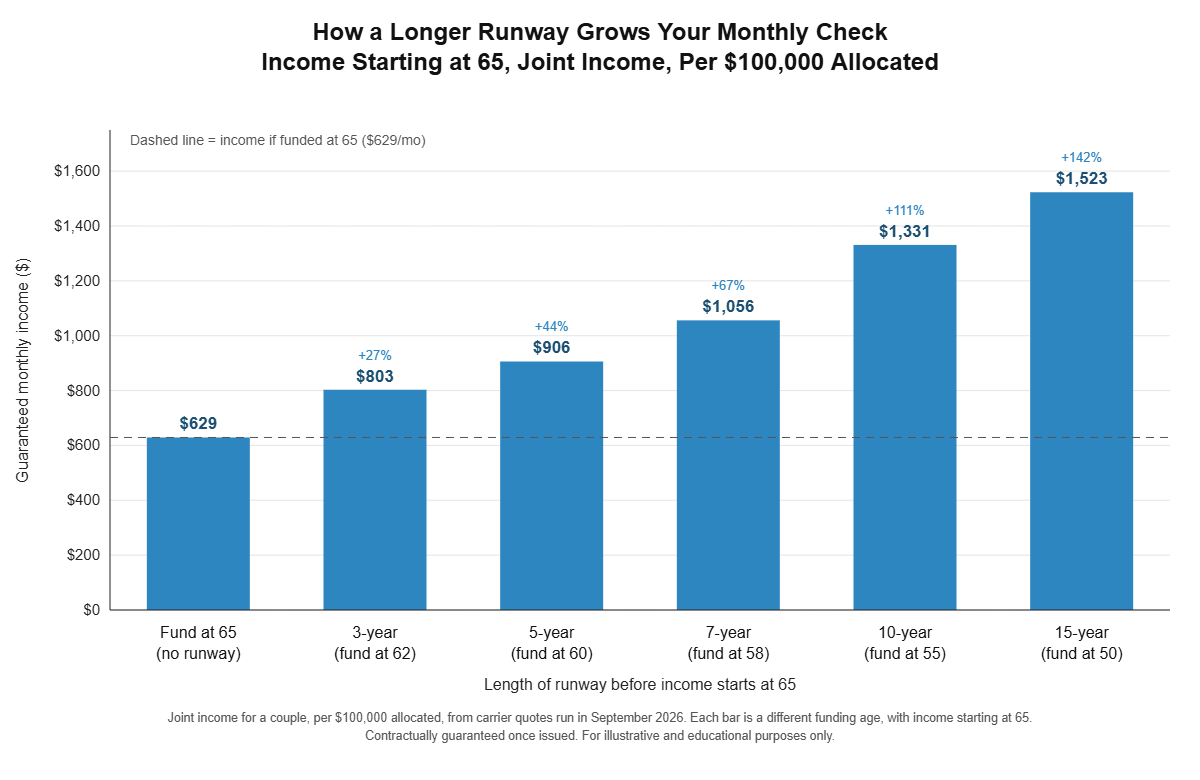
Funding a Fixed Indexed Annuity with a Guaranteed Lifetime Withdrawal Benefit up to 15 years before retirement can significantly increase your future guaranteed payout and income base, often producing much higher starting lifetime income than waiting until retirement to fund. A joint couple allocating $100,000 of their savings at age 50 and activating income at 65 can expect approximately $1,523 per month, compared to $629 per month for a couple who funds and activates at 65. That is about 2.4 times the guaranteed monthly income from the same $100,000, simply by starting sooner. The strategy gives you full flexibility on your income start date, and lets you know the exact contractually guaranteed income for every possible activation year before you commit to anything.
The runway is one lever inside a bigger plan. See the whole picture in your retirement paycheck.
Waiting has a cost, and it comes out of your retirement paycheck.
Many people wait until the year they retire to think about income. By then, they may have given up years of time that could have meant more guaranteed income from the money they allocate. The runway can be up to 15 years before you retire, and every year you wait can shorten it. Don’t find out at 65 what you could have had if you’d started sooner. Book a free 15-to-30-minute Retirement Income Blueprint Call and see where you stand today. First your life, then your money.
How the FIA + GLWB Runway Strategy Works
Most people think of annuities as something you fund at retirement when you need income to start. The runway strategy flips that assumption. Instead of waiting until your retirement date, you fund a FIA with GLWB up to 15 years before you plan to retire. During that deferral period, two things grow simultaneously: your income base, which grows at a contractually guaranteed rollup rate, and your payout factor, which increases the longer you defer. When you are ready to activate income, both of those numbers are significantly higher than they would have been if you had waited.
The bigger check then runs for as long as you are here. That’s the part you can count on. J.P. Morgan gives a non-smoking 65-year-old woman in excellent health a 54% chance of reaching 90 and a couple a 44% chance one of them reaches 95.12 Ten extra years of rollup paid across thirty years of income is a different deal than ten years of rollup paid across fifteen, so look at how long the income is likely to run.
You do not have to decide your exact retirement date when you fund the strategy. Unlike a DIA, which requires you to lock in your income start date at purchase, a FIA with GLWB lets you choose when to activate income after the deferral period ends. You will know the exact guaranteed monthly income for every possible start date before you commit to anything. That flexibility is one of the most important advantages of this approach over other deferred income products.
Our standard for the runway used to be up to 10 years before retirement. With current interest rates, a runway of up to 15 years has become more attractive, so we widened it. Interest rates and the income figures carriers offer can change often, sometimes daily. We review them periodically and update this page when meaningful changes have happened. Within that window, the earlier you fund, the more income you can lock in for life.
Why Deferral Duration Dramatically Affects Your Guaranteed Income
The income difference between funding immediately at retirement versus funding 10 to 15 years earlier is not incremental. It is transformational. Here is why.
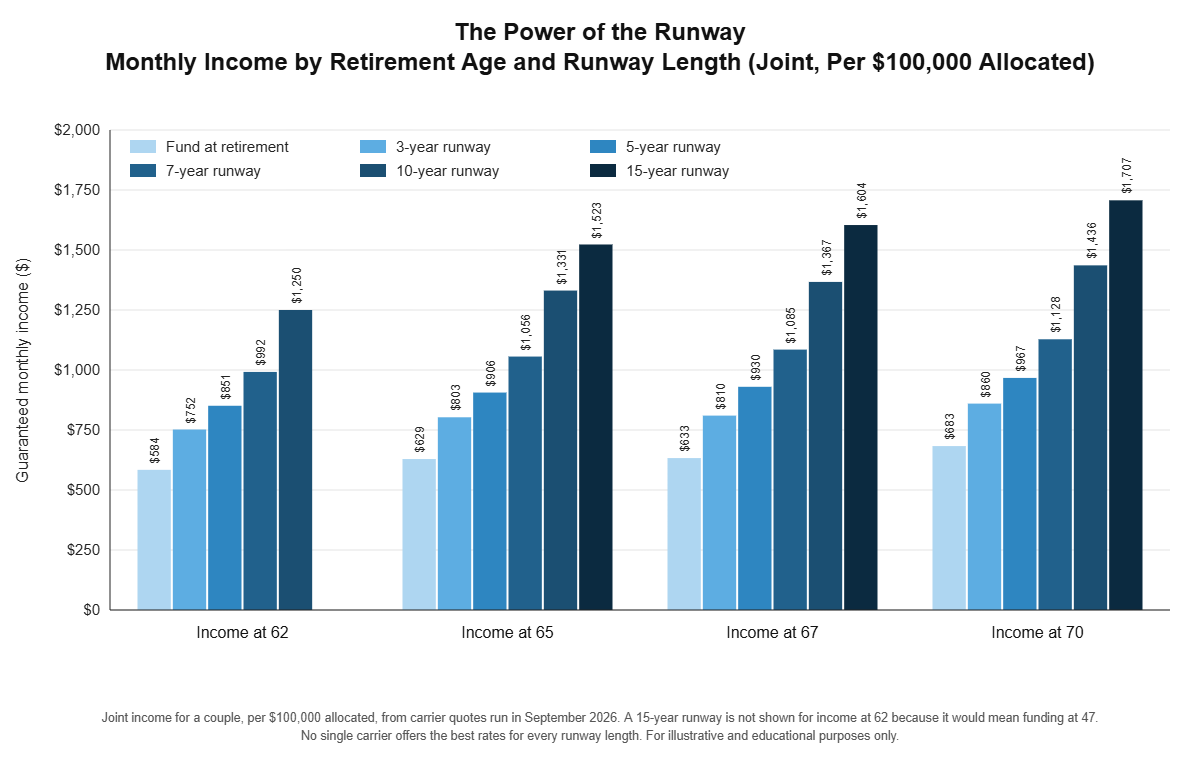
During the deferral period, your income base grows at a guaranteed rollup rate specified in the contract, typically between 6% and 8% per year depending on the carrier and product.1 That growth is not tied to market performance. It is contractually guaranteed. At the same time, your payout factor, the percentage of your income base you are guaranteed to withdraw each year for life, also increases the older you are when you activate income. Both the base and the percentage are growing simultaneously. The result is a compounding effect on your future guaranteed income that makes starting early significantly more powerful than waiting.
The Numbers: How Much More Income Does the Runway Produce?
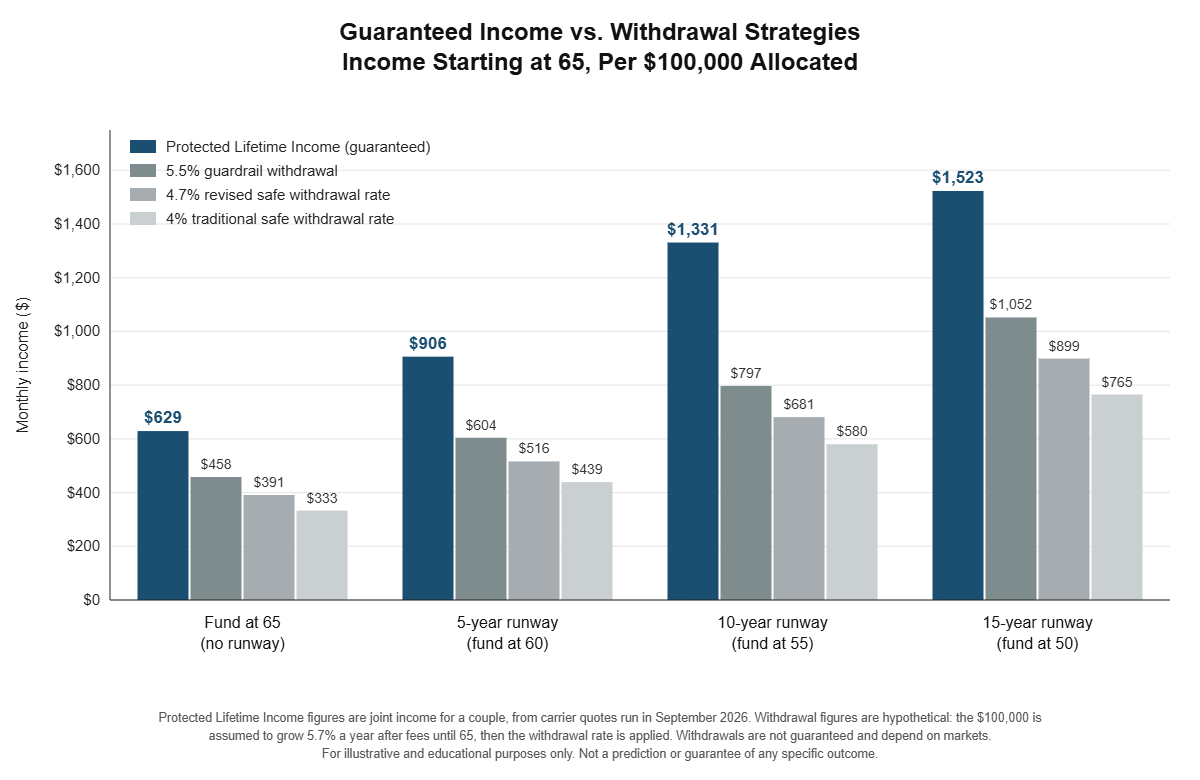
The table below compares guaranteed monthly income from a FIA with GLWB at different deferral periods against the equivalent monthly income from a traditional 4% portfolio withdrawal rule, all based on a $100,000 premium with income activating at age 65.
| Scenario | PLI Monthly Income | Portfolio 4% Rule | PLI Advantage |
|---|---|---|---|
| Immediate (fund and activate at age 65) | $629/mo | $333/mo | +$296/mo |
| 5-Year Runway (fund at 60, activate at 65) | $906/mo | $439/mo | +$467/mo |
| 10-Year Runway (fund at 55, activate at 65) | $1,331/mo | $580/mo | +$751/mo |
| 15-Year Runway (fund at 50, activate at 65) | $1,523/mo | $765/mo | +$758/mo |
Based on $100,000 premium, joint male/female scenario, income activating at age 65. If you are single, these numbers tend to be higher. PLI figures are from actual carrier quotes as of September 2026.1 Portfolio 4% Rule figures are hypothetical monthly equivalents of a 4% annual withdrawal from an account that grew at a hypothetical rate during the same deferral period. All figures are illustrative and for educational purposes only. Actual results will vary by age, health, carrier, product terms, and market conditions.
The 15-year runway produces $1,523 per month versus $629 for immediate funding, a 142% increase in guaranteed monthly income from the same $100,000 premium. The 10-year runway produces $1,331 per month, a 111% increase. Even a 5-year runway produces $906 per month, a 44% increase. And all four scenarios produce more guaranteed income than the traditional 4% safe withdrawal rate, the revised 4.7% safe withdrawal rate, or a 5.5% guardrail withdrawal strategy, without any market dependence for the essential income floor.
How Deferral Boosts Your Guaranteed Income
Key Features of the FIA + GLWB Runway Strategy
- Maximizes guaranteed income: Designed to produce the highest possible contractually guaranteed monthly income by the time you activate, particularly effective for joint couples who want both spouses covered for life.
- Remaining account value goes to heirs: Unlike SPIAs or DIAs, your account value remains accessible subject to contract terms, and any balance left when the last spouse passes away goes to your named beneficiaries at death.
- Flexible income start date: You do not lock in your retirement date years in advance. You fund the strategy now and choose your activation date when you are ready.
- Contractually guaranteed income for every start date: You know exactly what your monthly income will be for every possible activation year before you commit to anything.
- No forced annuitization: You maintain control and flexibility throughout the deferral period. You are not required to convert the contract to an annuity stream.
- Works with Roth, IRA, or after-tax dollars: Tax treatment depends on the funding source, giving you flexibility to fund from whatever account makes the most sense for your overall income plan.
- Can be laddered: You can fund multiple contracts in stages across different years to diversify your income start dates and build even more flexibility into your plan.
Who Is This Strategy Best Suited For?
- Pre-retirees between age 50 and 65 who want to maximize their future guaranteed income before they need it
- Couples who want the highest possible joint lifetime income with full flexibility on when to activate
- Anyone who wants to lock in income guarantees before retirement while keeping their options open on timing
- People who want access to their account value during the deferral period, with any balance left at death going to heirs
- Those concerned about market risk, sequence of returns risk, or the possibility of outliving their savings
- Anyone eyeing an early exit, since this is exactly the runway a 55-year-old can use
- Anyone who wants to use Roth, IRA, or after-tax dollars strategically for income floor planning
If your savings are in a 401(k), see how much each $100,000 could pay you per month, with and without a runway, in How Much Will My 401(k) Pay Me Per Month?
How This Strategy Fits Into Lifestyle-First Planning
In a Lifestyle-First retirement income plan, the income floor covers your essential expenses and non-negotiable experiences with guaranteed income that markets cannot touch. The runway strategy is how you build that income floor at the highest possible level for the least possible premium outlay.
By funding the FIA with GLWB a decade before you need income, you are essentially buying wholesale rather than retail. The same $100,000 premium that produces $629 per month at retirement produces $1,331 per month when funded 10 years earlier. That difference, $702 per month in additional guaranteed income1, frees up more of your growth assets to remain invested for long-term purchasing power and legacy rather than being needed for essential expenses.
The runway strategy also pairs naturally with Social Security delay. If you are planning to retire at 70, funding the annuity at 60 and waiting on Social Security until 70 push both income sources to their highest level in the same year. The two guaranteed income sources together, an optimized PLI income floor and a maximized Social Security benefit2, can create an income foundation that covers your essentials completely without any market dependence.
Myths and Truths About the FIA + GLWB Runway Strategy
- Myth: You have to decide your exact retirement date right now to use this strategy.
Truth: You fund the strategy today and choose your income start date when you are ready. You will know the exact guaranteed monthly income for every possible activation year before you commit to anything. - Myth: Your money is locked away during the deferral period.
Truth: You retain access to your account value subject to contract terms and any applicable surrender charges. Your money is not inaccessible. - Myth: This strategy only works with traditional IRA dollars.
Truth: You can fund using Roth, IRA, or after-tax dollars. Tax treatment on the resulting income simply depends on the funding source. - Myth: If you pass away before activating income, the insurance company keeps your account value.
Truth: Your account value passes to your named beneficiaries. Once income starts, payments and the rider fee draw the account value down. If it reaches zero, nothing is left to pass on, but the income continues for life. - Myth: The income base growth during deferral depends on how well the market index performs.
Truth: For the highest-income designs, the income base grows at a contractually guaranteed rollup rate regardless of index performance. Your guaranteed income is not dependent on market returns during the deferral period. - Myth: All FIA with GLWB products offer the same runway benefits.
Truth: Payout rates, rollup rates, rider fees, and contract terms vary significantly between carriers. Always compare real current quotes before choosing a product.
What Does Warren Buffett Say About Fixed Index Annuities?
Nothing that we could find. We went through Berkshire Hathaway’s shareholder letters from 2000 through 2024 and his best-known public remarks, and found no mention of fixed index annuities.13
His comments on record were about a different product, variable annuities with guarantees, and he was talking about the risk to the insurance companies that sold them.14 That comment, and why it matters, is on our page Are Annuities Safe? What Are the Pros and Cons?
What Does Dave Ramsey Say About Fixed Index Annuities?
His published material doesn’t single them out. Ramsey Solutions’ annuity article covers fixed and variable annuities and says, “For most people, an annuity just doesn’t make sense”.15 It points to fees, surrender periods, inflation and complexity, and recommends investing in a 401(k) and Roth IRA in growth stock mutual funds that it says return 10% to 12% over time.15 In his own column, Ramsey called a fixed annuity “a CD with a huge set of fees”.16
He’s right that fees on certain products and surrender periods are real. Ask about both.
Where we split: he’s comparing an annuity to an investment. We use it for a different job. A fund’s average return doesn’t tell you how much you can safely spend each year. Morningstar’s research puts the safe starting withdrawal rate for 2026 at 3.9%.17 We use a fixed indexed annuity with a guaranteed lifetime withdrawal benefit (GLWB) for income that lasts as long as you do, for the right amount, never all of your money. Our strategies are designed to cover your essentials, your adventures, your experiences, and the memories with the people you love. The rest stays liquid, with room to grow. The trade-off: the money committed to guaranteed income is less liquid, and you are depleting the money you committed to income. Your family’s overall legacy doesn’t have to shrink, though. With the income covered, the rest of your money isn’t being sold to pay the bills, even in a down market. That makes it less exposed to sequence of returns risk, and it can be invested more like it was when you were working. A family that isn’t forced to sell during a bad first few years of retirement may end up leaving more.
Pros and Cons of the FIA + GLWB Runway Strategy
Pros:
- Nearly double the guaranteed monthly income compared to funding at retirement using the same premium
- Full flexibility to choose your income start date without locking in years in advance
- Account value remains accessible, and whatever is left at death passes to heirs
- Income base growth during deferral is contractually guaranteed, not market dependent
- Works with Roth, IRA, or after-tax dollars for maximum planning flexibility
- No forced annuitization: you stay in control throughout the deferral period
- Can be laddered across multiple funding years or contracts for even more flexibility
Cons:
- Some products carry income rider fees and surrender charge periods that vary by carrier
- Guaranteed income amounts are based on contract terms, not actual account value growth or market performance
- Not all products or carriers are available in every state
- Guarantees rely entirely on the issuing insurer’s claims-paying ability
- May not be appropriate for those who need full liquidity or who do not expect to need guaranteed income in retirement
- Strategy can become less efficient beyond 15 years for many product designs
Planning in Missouri, Florida, Kansas, Nebraska, and Iowa
The runway strategy works in all five states KJ Financial serves, but state rules affect how the income is taxed, what guaranty association protections apply, and which carrier products are available. Missouri, Florida, Kansas, Nebraska, and Iowa each have their own tax treatment rules for annuity income depending on the funding source, and guaranty association coverage limits vary by state.11 KJ Financial is licensed in all five states and builds runway strategies that account for your specific state’s rules alongside your overall income and tax plan.
Summary
The FIA + GLWB runway strategy is one of the most powerful tools available for maximizing guaranteed lifetime income well before you retire. By funding up to 15 years before your target retirement date, you can double or more than double your guaranteed monthly income from the same premium, keep your income start date flexible, pass any remaining account value to your heirs, and know exactly what your income will be for every possible activation year before you commit to anything. For couples who want to protect both spouses for life and for anyone who wants to build one of the strongest possible income floors before markets can interfere, the runway strategy deserves serious consideration. Always compare real current quotes from multiple carriers before choosing a product, because payout rates and contract terms vary significantly.
Every year you wait can mean less income from the same money. See your runway today.
Frequently Asked Questions
State tax answers below are sourced to items 6 through 10 in the Sources list at the bottom of this page.
How does the runway strategy compare to a SPIA or DIA for deferred income?
A SPIA cannot be used for deferred income at all. It is an immediate income product only. A DIA allows deferral but requires you to lock in your income start date at purchase and surrenders your principal with no death benefit unless you add a rider. The FIA with GLWB runway strategy defers income like a DIA but gives you flexibility on the start date, keeps your account value accessible until income starts, and any balance left at death goes to your beneficiaries. And based on actual September 2026 quotes, the GLWB produces higher guaranteed income than the DIA at both 5-year and 10-year deferral periods.
Is the runway strategy right for everyone?
It is most appropriate for pre-retirees between age 50 and 65 who want to maximize future guaranteed income, preserve flexibility on their income start date, and build a Protected Lifetime Income floor before they need it. It is not appropriate for those who need full liquidity, those who do not plan to use the income in retirement, or those who expect to spend all assets before retirement. The fit depends on your specific age, health, funding source, and overall retirement income plan.
What is a Protected Lifetime Income floor and why does starting early matter so much?
A Protected Lifetime Income floor is a guaranteed income stream that covers your essential expenses regardless of market conditions. Starting early matters because both your income base and your payout factor grow during the deferral period, compounding your future guaranteed income in a way that cannot be replicated by waiting. The difference between funding at age 55 versus 65 can be nearly double the monthly income from the same premium, a gap that cannot be closed later without significantly more capital.
How does the runway strategy protect against sequence of returns risk?
By locking in a guaranteed income floor before you retire, the runway strategy ensures that essential expenses are covered by PLI income from day one of retirement. That means a market downturn in year one or two of retirement cannot force you to sell growth assets at depressed prices to pay your bills. Your income floor is already in place and fully funded. Your growth assets can stay invested and recover without being depleted at the worst possible time.
Does the runway strategy protect against inflation?
The guaranteed monthly income from a standard FIA with GLWB is fixed and does not automatically adjust for inflation unless you add a cost-of-living adjustment rider, which reduces the starting payout. In a Lifestyle-First plan, the growth asset layer handles long-term inflation protection. The spending smile concept also means your fixed PLI income often functions as a natural inflation hedge through your Slow-Go years when spending typically declines significantly from your Go-Go years.
How do Roth conversions interact with the runway strategy?
Funding the runway strategy with Roth dollars produces PLI income that is completely tax-free and does not count toward your MAGI for IRMAA purposes. Strategic Roth conversions in the years before you fund or activate your PLI strategy can significantly reduce the tax cost of future income. The combination of a Roth-funded runway strategy and strategic conversion planning before RMDs begin is one of the most powerful tax-optimization approaches available for pre-retirees.4
How does the runway strategy interact with Social Security claiming timing?
If you are planning to retire at 70 rather than earlier, one decision does two things at once. Funding the annuity at 60 and deferring activation the full 10 years produces substantially more guaranteed monthly income than funding at retirement. Waiting until 70 also lets your Social Security grow from what it would have been at 62 to its maximum, an increase of about 77% permanently. Both income sources reach their highest level in the same year, giving you a significantly higher guaranteed income for the rest of your life.
Does PLI income from the runway strategy affect Medicare IRMAA surcharges?5
It depends entirely on the funding source. Pre-tax funded PLI income counts as ordinary income and can push you into higher IRMAA brackets. After-tax funded PLI income uses an exclusion ratio where only the earnings portion is taxable.3 Roth-funded PLI income does not count toward MAGI and has no effect on IRMAA. Choosing the right funding source for your runway strategy is an important part of long-term Medicare cost management.
Does Missouri tax PLI income from the runway strategy?
As of 2026, Missouri fully exempts Social Security benefits from state income tax for anyone age 62 or older, with no income limits.6 PLI income funded with pre-tax dollars is taxable as ordinary income at both the federal and Missouri state level. PLI income funded with after-tax or Roth dollars may have more favorable tax treatment depending on the funding source and structure.
Does Florida tax PLI income from the runway strategy?
Florida has no state income tax, making it one of the most favorable states for receiving PLI income from any funding source. Social Security, annuity income, and investment withdrawals are all completely free from state taxation in Florida.9
Does Nebraska tax PLI income from the runway strategy?
Nebraska fully exempts all Social Security benefits from state income tax with no income thresholds or phase-outs.7 PLI income funded with pre-tax dollars remains taxable at both the federal and Nebraska state level depending on the funding source.
Does Kansas tax PLI income from the runway strategy?
Kansas fully exempts all Social Security benefits for every resident, with no income threshold.8 Choosing between pre-tax and after-tax funding sources for a runway strategy still matters for Kansas retirees because it affects federal taxes and IRMAA, even though the state exemption is now automatic.
Does Iowa tax PLI income from the runway strategy?
Iowa does not tax Social Security at any age and also exempts most qualifying retirement income for residents age 55 or older.10 PLI income tax treatment in Iowa depends on the funding source and whether it qualifies as exempt retirement income under Iowa law.

Experience: Since founding KJ Financial in 2010, Kurt H. Jackson has worked with retirees and pre-retirees across Missouri, Nebraska, Kansas, Iowa, and Florida who discovered that the retirement plan they had built around a fixed withdrawal rule was far more fragile than they realized. He has worked directly with clients coming out of the 2008 crash, and with clients who retired into the 2020 COVID drop and the inflation spike of 2021 to 2023, and he has seen firsthand what sequence of returns risk does to a withdrawal-only strategy versus a Lifestyle-First plan with a guaranteed income floor. Before founding KJ Financial, he spent 20 years as a Certified Mortgage Planner working with more than 1,000 clients on major financial commitments, giving him deep insight into how financial decisions compound over time.
Expertise: Kurt is a Retirement Lifestyle Architect and the creator of the Lifestyle-First Retirement Income Planning framework. He builds guaranteed lifetime income, which he calls Protected Lifetime Income (PLI), under both his clients’ essentials and their non-negotiables, the adventures, the experiences and the memories with those they care about. With that income floor in place, the rest of their money no longer has to pay the bills, which means it doesn’t have to be sold in a down market. He is Life and Health Insurance Licensed in MO, NE, KS, IA, and FL. His practice focuses exclusively on insurance-based, tax-optimized retirement income strategies. He does not manage investments or sell securities.
Authoritativeness: Kurt founded KJ Financial and operates MaxMyRetirementIncome.com as a dedicated educational resource for retirees. His work is grounded in peer-reviewed and independently published research, cited directly on each page. He applies that research to the practical income planning decisions retirees face every day in the states he serves.
Trustworthiness: KJ Financial is a compliance-first firm. All figures and research citations on this page are sourced from publicly available, independently published studies and are linked directly in the content. Kurt is paid by commission from the insurance company that issues the policy. Kurt H. Jackson is not a securities broker, registered investment advisor, or CPA. Guarantees rely on the claims-paying ability of the issuing insurance company.
Contact KJ Financial:
1014 E. 5th St., Maryville, MO 64468
Direct: 816.582.5532
Email: kurt@kjfinancialonline.com
Website: www.MaxMyRetirementIncome.com
Educational only. Not tax, legal, or individualized investment advice. Guarantees rely on the issuing insurer’s claims-paying ability. Income figures shown are based on real rounded-down quotes from actual carriers as of 2026 and are subject to change before contract lock-in. Actual figures will differ based on age, health, carrier, product features, fees, and market conditions. State guaranty association coverage limits vary; see nolhga.com for your state’s details. Always consult a qualified financial, tax, or legal professional for your specific situation.
Saving for retirement isn’t the same as planning it.
A growing 401(k) can feel like a plan. It isn’t. It doesn’t tell you what your paycheck will be, how long it will last, or what happens if the market drops right before you retire. The sooner you know, the more options you may have, and some of those options can shrink with every year you wait. Find out in a free 15-to-30-minute Retirement Income Blueprint Call. First your life, then your money.
Return to the Retirement Income Answers Hub
Sources
- KJ Financial, current carrier quotes. The monthly income figures on this page are real quotes Kurt H. Jackson pulled from issuing carriers in 2026 for a joint male and female contract on a $100,000 premium, rounded down. They are not an industry average and not a projection. There is no public page to link, because carrier rates are quoted, not published, and they change.
- Social Security Administration, retirement age and benefit reduction. SSA’s table showing that for anyone born in 1960 or later, full retirement age is 67 and a benefit claimed at 62 pays $700 per $1,000, which is the basis for the increase between claiming at 62 and claiming at 70.
- IRS Publication 939, General Rule for Pensions and Annuities. The IRS rules for the exclusion ratio, under which part of each annuity payment from after-tax money is a tax-free return of your cost and only the rest is taxable.
- IRS Publication 590-B, Distributions from Individual Retirement Arrangements. The federal rules for IRA and 401(k) distributions and for why a qualified Roth withdrawal comes out tax free and does not add to your income.
- Social Security Administration, Medicare premiums and income-related adjustments. Social Security’s definition of the income it uses to set the Medicare surcharge, which is adjusted gross income plus tax-exempt interest, and the current surcharge table for Part B and Part D.
- Missouri Revised Statutes, Section 143.125. The Missouri statute granting the maximum Social Security exemption for all tax years beginning on or after January 1, 2024, regardless of filing status or Missouri adjusted gross income.
- Nebraska Revised Statutes, Section 77-2716. The Nebraska statute reducing federal adjusted gross income by one hundred percent of Social Security benefits for taxable years beginning on or after January 1, 2024, with no income threshold.
- Kansas Statutes, K.S.A. 79-32,117. The Kansas statute subtracting Social Security benefits for all taxable years beginning after December 31, 2023, with the former $75,000 income limit no longer applying.
- Florida Constitution, Article VII, Section 5. The Florida Constitution itself, which bars the state from levying a tax on the income of natural persons.
- Iowa Department of Revenue, IA 1040 Schedule 1 and retirement income tax guidance. Iowa’s official schedule of subtractions, which carries a Social Security Benefits line with no age or income condition, alongside a separate IRA and pension line that does carry the age 55 condition.
- National Organization of Life and Health Insurance Guaranty Associations. The guaranty association system, where coverage limits are set state by state.
- J.P. Morgan Asset Management, Guide to Retirement 2026, the Life Expectancy Probabilities page. J.P. Morgan’s own longevity chart for a non-smoker in excellent health who is age 65 today, giving a man a 64% chance of reaching 85, 43% of 90, 21% of 95 and 6% of 100; a woman 73%, 54%, 30% and 11%; at least one member of a couple 90%, 74%, 44% and 16%; and both members of a couple 47%, 23%, 6% and 1%.
- Berkshire Hathaway’s shareholder letters, 1977 to present.
- Reuters’ report “Buffett says life insurers took crazy bets,” as published by International Business Times. (May 4, 2009)
- Ramsey Solutions’ article “What Is an Annuity and How Does It Work?” (updated October 3, 2024)
- Dave Ramsey’s “Dave Says” column on annuities for long-term retirement, as republished by CBN.
- Morningstar’s 2026 research on safe retirement withdrawal rates.
New to this? Start with what a GLWB (guaranteed lifetime withdrawal benefit) is and how the rider works.