What About Required Minimum Distributions (RMDs)?
Last updated: September 9, 2026
Required Minimum Distributions (RMDs) are mandatory withdrawals the IRS requires from your traditional IRAs, 401(k)s, and similar retirement accounts. The starting age for RMDs is 73 if you were born between 1951 and 1959, and 75 if you were born in 1960 or later.1 Proactive, Lifestyle-First planning coordinates guaranteed lifetime income, which we call Protected Lifetime Income (PLI), Roth conversions, and withdrawal order to help you avoid tax spikes and protect your retirement lifestyle and legacy. Always confirm the latest rules at IRS.gov.
The IRS has a plan for your retirement savings. Do you?
Every dollar in a pre-tax account has a tax bill attached that hasn’t been paid yet. Starting at age 73 or 75, depending on the year you were born, required minimum distributions can force money out whether you need it or not. That can push you into a higher tax bracket, create taxes on your Social Security benefits and raise your Medicare premiums. Waiting until then can leave you with fewer choices. Find out where you stand in a free 15-to-30-minute Retirement Income Blueprint Call. First your life, then your money.
What Are RMDs and Why Do They Matter?
Required Minimum Distributions (RMDs) are the IRS-mandated withdrawals you must take each year from your traditional IRAs, 401(k)s, and similar retirement accounts. The starting age for RMDs is now 73 if you were born between 1951 and 1959, and 75 if you were born in 1960 or later. (IRS Publication 590-B)
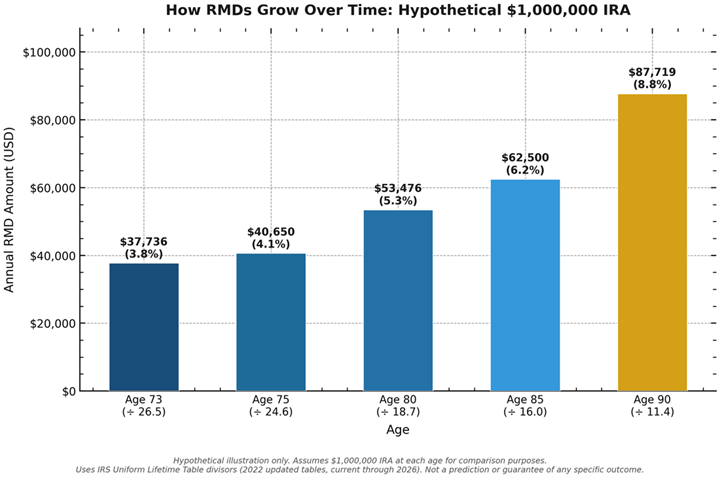
The amount you must withdraw is based on your age and account balance, using the IRS Uniform Lifetime Table:
- Age 73: Divisor 26.5
- Age 75: Divisor 24.6
- Age 80: Divisor 20.2
- Age 85: Divisor 16.0
- Age 90: Divisor 12.2
These divisors mean your required withdrawal, and the percentage of your account you must take, grows as you age.
If you miss an RMD, the penalty is 25% of the amount not withdrawn, but this drops to 10% if you correct the mistake promptly (usually within two years for IRAs). These rules are current as of 2026 under the SECURE Act 2.0.
Why RMDs Can Trigger the Tax Avalanche
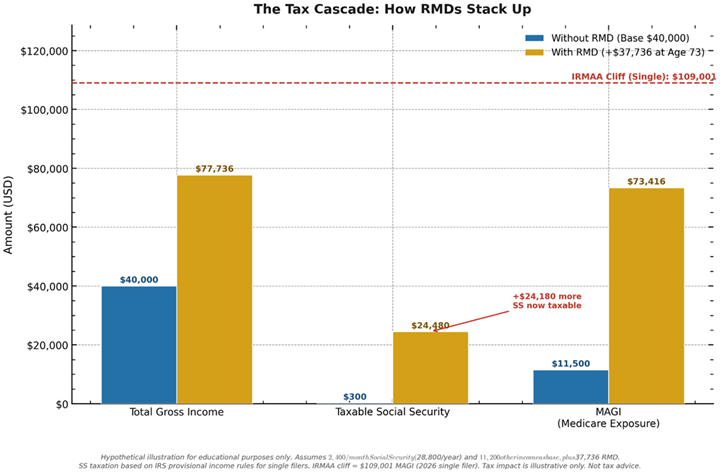
RMDs don’t just increase your taxable income, they can set off a chain reaction called the Tax Avalanche:
- RMDs increase income.
- Social Security becomes taxable (up to 85%).1
- Medicare IRMAA surcharges are triggered.2
- Loss of itemized deductions and credits.
- Widow’s Penalty (surviving spouse files single at same income).
- Taxes on inherited accounts (10-year rule applies).
This cascade can quietly erode your retirement income and legacy if you don’t plan ahead.
How RMDs Grow Over Time
The Tax Avalanche: How RMDs Stack Up
How Lifestyle-First Planning Manages RMDs
Lifestyle-First planning helps you avoid RMD-driven tax spikes by:
- Using Roth conversions before RMDs start to reduce future required withdrawals and taxable income.
- Coordinating withdrawal order to keep your income below key tax and IRMAA thresholds.
- Leveraging QCDs to satisfy RMDs while supporting your favorite charities.
- Protecting your essentials with Protected Lifetime Income (PLI), so you’re not forced to sell investments or take large withdrawals at the wrong time.
How do I avoid the RMD tax bomb?
“RMD tax bomb” is what most people call this, and it is a pretty accurate description. The key thing to understand is that it is not set at 73 or 75. It was set a little at a time, every month or year money went into a pre-tax 401(k) or IRA without a plan for the day it has to come back out.
The most direct answer is a Roth conversion
A Roth conversion moves money out of your pre-tax IRA or 401(k) and into a Roth IRA. You pay the tax on the amount you move in the year you move it. From that point on it grows tax-free, comes out tax-free, and it never subjects you or your surviving spouse to a required minimum distribution again.
That last part is why it sits at the top of this list. Every other move on this page manages the size of the problem. A conversion is the one that can take money out of the RMD calculation permanently.
Convert enough, early enough, and the required withdrawal at 73, or 75 if you were born in 1960 or later, can be a good deal smaller than it would have been. A smaller required withdrawal can mean less of your Social Security pulled into tax, less exposure to Medicare surcharges, and a smaller pre-tax balance handed to your children under the 10-year rule.
One detail worth knowing before you start. Each conversion carries its own five-year clock, so if you convert and then need to pull earnings back out within five years, the tax treatment is not the same. It rarely changes whether to convert. It can change when you touch the money. You can pull your initial principal out without taxes.
Bigger is not automatically better
Here is where most of what you read on this gets it wrong. Converting is not a good idea for everyone, and essentially there are two questions that drive the decision.
The first is whether you are a spender or a leaver.
A spender plans to use most of this money themselves. The IRA is the paycheck for the go-go years. For a spender, a conversion often does not help and can hurt. You pay a large tax bill today, then spend the account down anyway, and typically you never get enough years of tax-free growth to earn that upfront cost back. The part most people have backwards is that the longer a spender lives, the worse the conversion tends to look.
A leaver is more than likely to live on Social Security, maybe a pension, and not much more. The IRA ends up being money earmarked for their children. For a leaver, the math can flip. The account can compound tax-free for the rest of their life and then pass to their kids income-tax-free. The longer a leaver lives, the better it tends to look.
Plenty of people who would never call themselves wealthy are leavers, and for them this can matter more than it does for half the millionaires.
The second is where the tax money comes from.
If you can pay the conversion tax from money outside the IRA, that is the most efficient way to handle it.
It is not the only way, but the other methods do tend to reduce the benefit. Do not fall into the trap of assuming that paying the tax another way means a conversion could still not be worth doing.
Unfortunately, most of the Roth conversion calculators out there do not take all the relevant factors into account. They can make a conversion look like it makes sense when it does not, and the reverse. You deserve an analysis from a more in-depth calculator like the one we use at Tax Savvy Roth Conversions.
When the window is open
The stretch between the day you stop working and the day Social Security and required withdrawals begin is often when your taxable income is the lowest it will ever be. That is usually when a conversion costs the least.
That does not mean it is the only time to consider one. It means it is likely the most efficient time to do it.
Waiting until 73, or 75 if you were born in 1960 or later, generally means converting on top of income that is already high, which is the most expensive time to do it.
The moves that work alongside it
Watch the order you draw from. Which account you pull from can matter as much as how much. Income that crosses a Social Security threshold or a Medicare surcharge line can cost more than the withdrawal itself.
These are the lines to know. But if you have a very large pre-tax balance, it can still make sense to create a little more tax or surcharge along the way, as long as the overall result comes out ahead of not converting at all.
Do not let rules of thumb push you into conversions you should not do, or scare you away from ones you should.
Say a conversion strategy costs you $100,000 to $150,000 in extra tax and surcharges while you are doing it, and the result is an extra $500,000 to $750,000 or more passed on to your children, after you have lived the retirement you wanted. Would it be worth spending $100,000 to $150,000 to hand your family $500,000 to $750,000 or more?
That is a question only you can answer. But isn’t it a question you should be asked, instead of just assuming that because a conversion creates more tax now, you should not do it?
Get a comprehensive analysis that accounts for all the factors in your situation.
Give from the IRA if you give anyway. If you are already a giver, whether it is your church, your alma mater, or a cause you care about, why not use the tax law to offset a tax you are going to be forced to pay?
A Qualified Charitable Distribution sends money straight from your IRA to the charity, up to $111,000 per person in 2026. It counts toward your RMD and never lands in your income at all, so it cannot add to a tax spike or a Medicare premium surcharge. That beats taking the money, paying tax on it, and donating what is left.
Say your required withdrawal is $50,000 more than you need this year. If $50,000 is more than you would normally give, you can stack several years of giving into one and skip the tax on money you were not going to spend. And if $50,000 is about what you give anyway, why pay tax on it first?
Take the pressure off the withdrawals. When your essentials and the non-negotiables are covered by protected lifetime income, the money coming out of the IRA is not paying the light bill. That turns timing into a decision instead of a requirement, and on this subject timing is most of the game.
There is a little-known piece of this when the income was created with pre-tax IRA money. The income that contract pays you counts toward your required withdrawal for the year. That stays true even after the money inside the account is gone and you are into the insurance company’s pockets. How much of your total requirement it covers depends on the year-end value the carrier reports on that contract, so it is a number to ask them for. Hardly anyone realizes this counts at all.
Keep in mind, none of this makes RMDs disappear. What it can do is take the damage out of the Retirement Tax Avalanche.
Myths and Truths About RMDs
- Myth: “RMDs are just a minor tax issue.”
Truth: RMDs can trigger a chain reaction of higher taxes, Medicare surcharges, and lost deductions if not managed proactively. - Myth: “I can skip my RMD and just pay a small penalty.”
Truth: The penalty is 25% of the missed amount (reduced to 10% if corrected promptly), a significant hit to your savings. - Myth: “RMD rules haven’t changed in years.”
Truth: The starting age, penalty structure, and QCD limits have all changed recently. Always check the latest rules at IRS.gov. - Myth: “Roth IRAs have RMDs too.”
Truth: Roth IRAs do not have RMDs during your lifetime, making them a powerful tool for tax and legacy planning. - Myth: “QCDs are capped at $100,000.”
Truth: The QCD limit is indexed for inflation and is $111,000 per person in 2026.
Pros and Cons of Proactive RMD Planning
Pros of Lifestyle-First RMD Planning:
- Reduces the risk of tax spikes and IRMAA surcharges
- Helps avoid the Tax Avalanche
- Supports charitable giving through QCDs
- Coordinates with Protected Lifetime Income (PLI) for steady essentials
- Gives you more control over your retirement income and taxes
Cons:
- Requires careful, ongoing planning and review
- Missed RMDs can still trigger penalties if not corrected
- Some strategies (like Roth conversions) may create a temporary tax bill
- Rules and limits can change, so staying informed is essential
Summary
RMDs are more than just a required withdrawal, they can trigger a cascade of taxes and higher Medicare costs if you don’t plan ahead. Lifestyle-First planning helps you manage RMDs with strategies like Roth conversions, QCDs, and coordinated withdrawals, so you avoid tax spikes and keep your retirement on track. Always check the latest rules at IRS.gov to stay up to date.
Forced withdrawals start at 73 or 75. Know your tax picture before they do.

Experience: Since founding KJ Financial in 2010, Kurt H. Jackson has worked with retirees and pre-retirees across Missouri, Nebraska, Kansas, Iowa, and Florida who discovered that the retirement plan they had built around a fixed withdrawal rule was far more fragile than they realized. He has worked directly with clients coming out of the 2008 crash, and with clients who retired into the 2020 COVID drop and the inflation spike of 2021 to 2023, and he has seen firsthand what sequence of returns risk does to a withdrawal-only strategy versus a Lifestyle-First plan with a guaranteed income floor. Before founding KJ Financial, he spent 20 years as a Certified Mortgage Planner working with more than 1,000 clients on major financial commitments, giving him deep insight into how financial decisions compound over time.
Expertise: Kurt is a Retirement Lifestyle Architect and the creator of the Lifestyle-First Retirement Income Planning framework. He builds guaranteed lifetime income, which he calls Protected Lifetime Income (PLI), under both his clients’ essentials and their non-negotiables, the adventures, the experiences and the memories with those they care about. With that income floor in place, the rest of their money no longer has to pay the bills, which means it doesn’t have to be sold in a down market. He is Life and Health Insurance Licensed in MO, NE, KS, IA, and FL. His practice focuses exclusively on insurance-based, tax-optimized retirement income strategies. He does not manage investments or sell securities.
Authoritativeness: Kurt founded KJ Financial and operates MaxMyRetirementIncome.com as a dedicated educational resource for retirees. His work is grounded in peer-reviewed and independently published research, cited directly on each page. He applies that research to the practical income planning decisions retirees face every day in the states he serves.
Trustworthiness: KJ Financial is a compliance-first firm. All figures and research citations on this page are sourced from publicly available, independently published studies and are linked directly in the content. Kurt is paid by commission from the insurance company that issues the policy. Kurt H. Jackson is not a securities broker, registered investment advisor, or CPA. Guarantees rely on the claims-paying ability of the issuing insurance company.
Contact KJ Financial:
1014 E. 5th St., Maryville, MO 64468
Direct: 816.582.5532
Email: kurt@kjfinancialonline.com
Website: www.MaxMyRetirementIncome.com
Educational only, not tax, legal, or individualized investment advice. Guarantees rely on the issuing insurer’s claims-paying ability. Any figures shown are illustrative and may differ for your situation based on age, health, product features, fees, allocations, and market conditions. RMD ages, QCD limits, and tax rules are current as of 2026 and are subject to change. Always confirm current rules at IRS.gov and consult with a qualified tax or legal professional.
Your savings may not be as big as the statement says.
If much of your money is in a 401(k) or traditional IRA, part of that balance was never yours to spend. It belongs to the IRS, and the bill comes due when you take it out. Every dollar lost to taxes is a dollar that can’t go to the adventures, the experiences and the memories you’ve been waiting for. In a free 15-to-30-minute Retirement Income Blueprint Call, we look at what you’ll really have to spend. First your life, then your money.
Sources
- IRS, Retirement plan and IRA required minimum distribution FAQs. The IRS page setting out when required withdrawals from a traditional IRA or workplace plan must begin, and stating that for an owner who dies after December 31, 2019 the SECURE Act requires the entire inherited balance to be distributed within ten years.
- Social Security Administration, Medicare premiums: rules for higher-income beneficiaries. Social Security’s explanation of the income-related monthly adjustment amount, IRMAA, which applies to both Part B and prescription drug coverage, is charged to each beneficiary, and is set from the most recent federal tax return the IRS provides, which is why a one-year rise in income shows up two years later.
See it on your own numbers
Want to see your own Tax Avalanche?
A general warning is easy to wave off. Your own number is a lot harder to ignore. Put in a few rough figures and watch the cascade unfold, the withdrawal the government will force you to take, how much of your Social Security it can drag into being taxed, and what it can do to whichever spouse is left behind. It takes about two minutes, and you walk away with a one-page snapshot to keep.
Show me my Tax Avalanche